Aftermarket strategyNovember 11, 202610 min read
Build the Machine, Rent the Plumbing.
PMPat McCarthy
Core vs Context in the age of agentic AI: why faster software creation makes strategic focus more urgent, not less, for industrial OEMs choosing how to source aftermarket software.
Table of contents
Bring us one representative machine. We will show you the aftermarket opportunity.
For most equipment manufacturers, aftermarket software for parts, service and support is context, not core. The winning move is to rent it from a flexible partner, then put your scarce engineers and your speed into the machine and the business model.
Nine days to a demo
Last month, I sat down with the CIO of a major equipment manufacturer who could barely contain his pride, and it was easy to see why. His team had just vibe-coded a working aftermarket parts-ordering portal in nine days. The interface was clean, search worked, the shopping cart worked, and it even had a conversational AI assistant layered on top. Ten years ago, getting a prototype like that in front of leadership would have taken six months and a seven-figure systems integration budget.
I love that kind of builder energy. But as we talked through moving that portal from a conference-room laptop into daily production across their dealer network, the conversation shifted from code to operations. What happens when a customer orders a replacement part for a machine modified on-site in 2019, and nobody ever updated the bill of materials? Who owns the regression testing and patches the portal next quarter when the underlying AI model updates and subtly changes how it interprets part numbers? And most importantly, who answers the phone at 2 a.m. when a West Texas technician is standing next to a down machine, needing a torque spec?
The CIO was not wrong to be proud of his team; they had built something impressive in record time. The trap was not the demo. It was confusing the cost of building software with the cost of owning it. Those have always been two very different numbers, and generative AI has quietly stretched the gap between them wider than ever.
I have seen this movie before, and the market just tested it
Having started my career in supply chain operations and spent decades in enterprise and ERP software, I have watched this movie play out every ten years. First, companies tried to build their own custom ERPs, then homegrown CRMs, then bespoke ecommerce portals. Nearly every one of those investments was eventually written off, not because the engineers lacked talent, but because leadership blurred the line between core and context.
Earlier this year, the public stock market tested the “just build it” thesis in real time. In early February 2026, a burst of new AI agent launches convinced investors that companies would simply build what they used to buy. Roughly $285 billion disappeared from software stocks in 48 hours during what traders dubbed the “SaaSpocalypse,” and within a week US software stocks shed nearly $1 trillion. Then enterprise customers answered with their budgets. Earnings came in strong, and by October Reuters reported that US software stocks were setting fresh 2026 highs, with expected sector earnings growth rising from 13.8% to 20.6%.
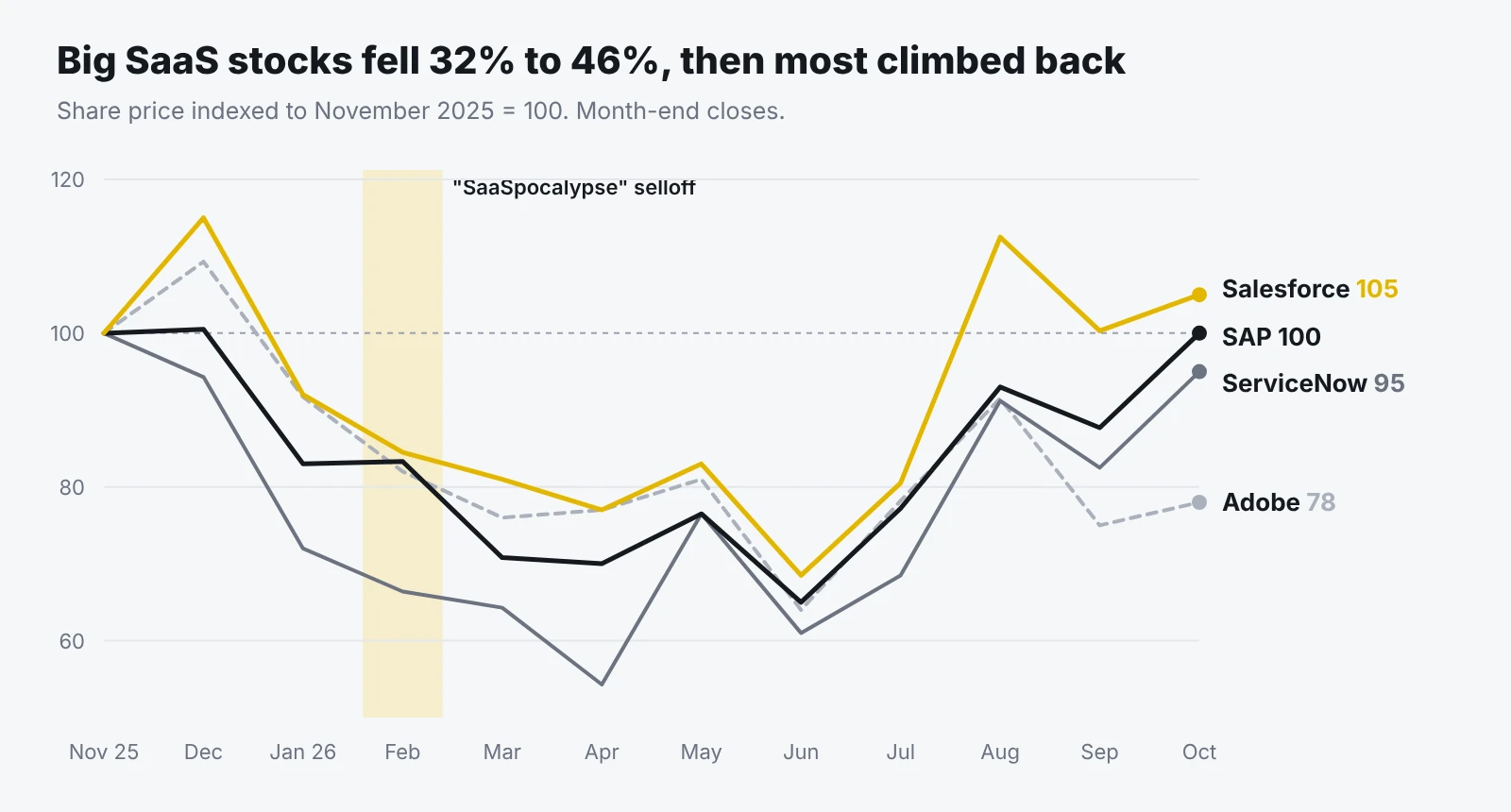
Digrin monthly share prices, November 2025 to October 2026, indexed.
SAP and Salesforce are back at or above their November 2025 month-end levels and ServiceNow is close behind. Adobe, still well below, is a reminder that the rebound rewarded some business models more than others.
What the rebound tells an industrial leader: investors priced in the idea that code is now cheap. Customers kept paying anyway, because what they buy from a good software provider was never the code. It is accumulated best practice, continuous maintenance, accountability and speed to value.
Core vs Context: the test that still works
Geoffrey Moore gave us the cleanest tool for this decision in Dealing with Darwin. Core is any activity that creates sustainable differentiation, the reason customers pay more or switch suppliers. Context is everything else. Moore’s mantra is blunt: “extract resources from context to repurpose for core.”
His second axis matters just as much: mission-critical versus non-mission-critical. That creates four quadrants, and the one that traps companies is mission-critical context. These are processes where a failure creates “serious and immediate risk,” but where excellence does not differentiate you. Moore observed that successful, mature companies tend to accumulate their resources here, precisely because it feels too important to hand to anyone else.
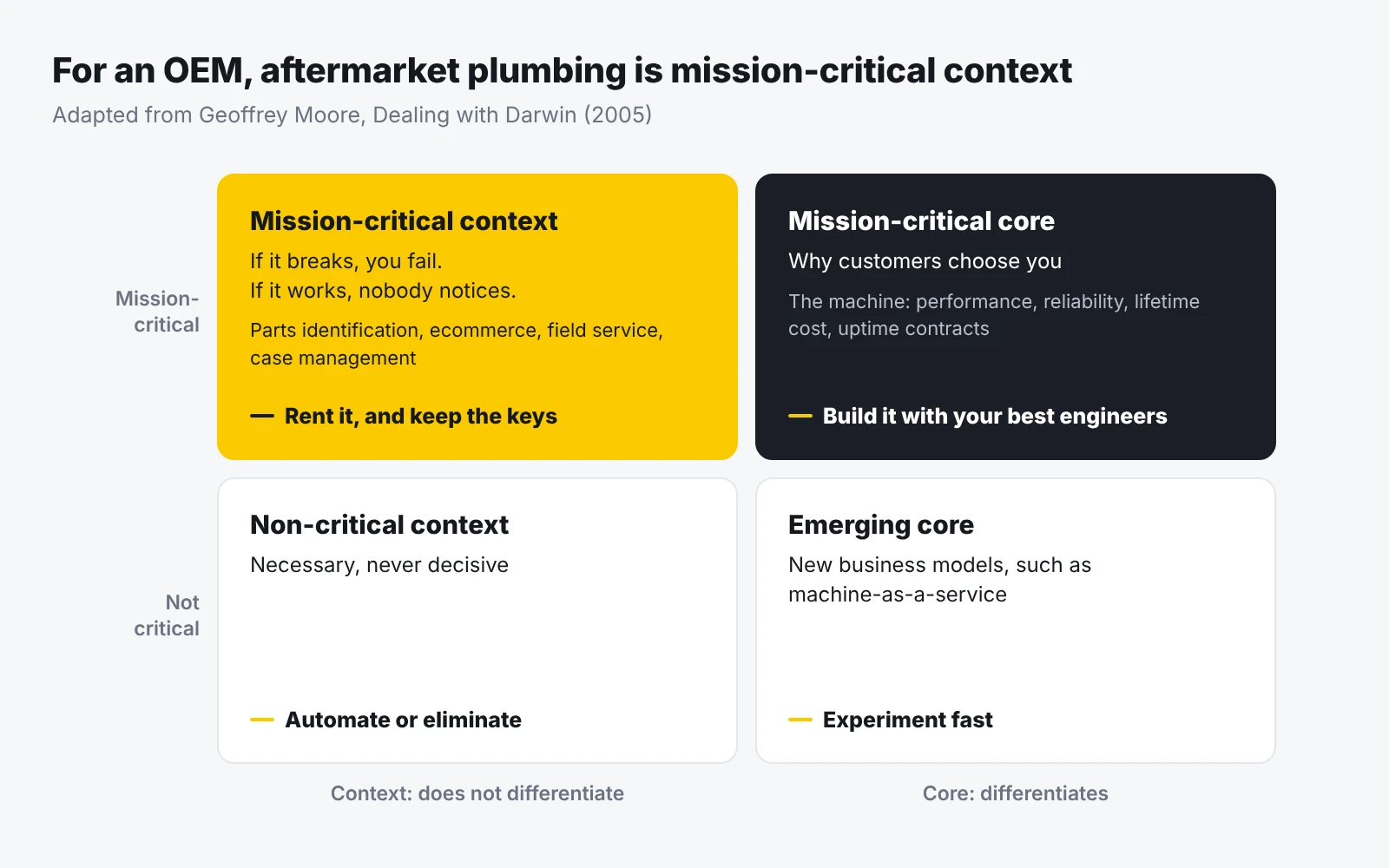
Core vs Context for an industrial OEM, after Geoffrey Moore: aftermarket software is mission-critical context.
For an industrial OEM, apply the test honestly:
- Core: the best machine, measured in performance, efficiency and reliability. Machines that last longer and cost less to own. Lower energy, emissions and waste. And increasingly, the business model: uptime guarantees, outcome-based pricing, machine-as-a-service.
- Mission-critical context: asset master data, parts identification, ecommerce, field service management, case management, knowledge delivery and the AI co-pilot sitting on top. If these break, technicians stand idle and customers get angry. But no customer has ever bought an excavator because the OEM’s ticketing screen was elegant.
Customers buy a machine that runs. Investors value margin, growth and return on capital. Neither one values your homegrown case management system. That is why specialist aftermarket platforms such as Industrility, which I advise, exist: to bring practice learned across many manufacturers to a problem each one would otherwise solve alone.
A note on data: your proprietary field data is crown-jewel fuel. Protect it ferociously through contract: OEM ownership of the data and of any models trained on it, plus a tested exit. Just do not confuse owning the intelligence inside your data with building the commodity plumbing that moves it.
AI is democratizing IP
Every day, I work with enterprise leaders deploying agentic AI workflows to transform how their organizations operate. AI accelerates how teams design, build and modernize software across the enterprise. But speed to code is not speed to customer value, and the fastest way to burn engineering velocity is to point AI at rebuilding software someone else has already perfected.
Simon Wardley’s capability mapping offers a useful lens here: every capability evolves from genesis, to custom-built, to product, to commodity. AI has placed standard application features, such as parts search, case screens and basic chat interfaces, on a fast escalator toward commodity. Clayton Christensen’s law of conservation of attractive profits explains where value migrates when one layer commoditizes: it moves to adjacent layers that remain hard. For OEMs, those defensible layers are the physical machine and the commercial outcome guaranteed around it.
The highest-return AI projects target specialized domain bottlenecks that only your industry faces. For example, Industrility built an intelligent maintenance engine that ingests complex equipment manuals and cuts a two-month manual engineering project down to three hours. That is AI applied to deep industrial expertise, not to rebuilding commodity plumbing.
The scarce resource is not software. It is engineering talent. Every engineer maintaining a homegrown ticketing system is an engineer not working on a longer-life bearing, a more efficient drivetrain or the analytics behind a new uptime contract.
Where the moat actually is: business-model innovators
The industrial companies that built durable advantage did not win on software features. They won by changing what the customer pays for, and they used software in service of that promise.
History offers a useful parallel. When electric power first reached American factories around 1900, manufacturing productivity barely budged for twenty years. Plant managers simply swapped out the steam engine to turn the same overhead line shaft. Step-function gains only arrived when leaders ripped out the line shaft and reorganized the factory floor around unit-drive power. Using AI to vibe-code a homegrown parts portal or ticketing tool is the modern equivalent of electrifying the line shaft.
- Rolls-Royce invented “Power-by-the-Hour” in 1962, offering complete engine and accessory replacement on a fixed cost per flying hour. Six decades later, that idea (now TotalCare and CorporateCare) is the template for outcome-based industrial contracts. The business model was the moat; the software served it.
- Otis launched its Otis ONE IoT service platform in 2018 with data from more than 300,000 connected units, rented its connectivity and cloud, and kept its own focus on the elevator service model. Its FY2025 10-K reported approximately 1.1 million connected units.
- Signify (then Philips Lighting) sold Amsterdam’s Schiphol Airport “light as a service” in 2015: Schiphol pays for the light it uses while the manufacturer keeps ownership of the fixtures. Kaeser does the same with compressed air, charging a pre-agreed price per cubic metre instead of selling compressors.
- John Deere is the instructive hybrid. It built machine intelligence into the equipment itself, which is core, but bought rather than built the computer-vision technology, acquiring Blue River Technology for $305 million in 2017.
The pattern: unless software itself is the product you sell, durable industrial advantage comes from investing your best engineers where customers feel the difference, and renting the rest.
The $1B manufacturer, in numbers
The following model is illustrative. The assumptions are my estimates, with a range of roughly ±40%, so replace them with your own.
Assumptions: $1B revenue, 25% from the aftermarket ($250M), 15% EBITDA. These are reasonable against published benchmarks. McKinsey found average EBIT margins of 25% for aftermarket services versus 10% for new equipment across 30 industries, and BCG reports that service gross margins are typically twice the 15% to 25% earned on equipment.
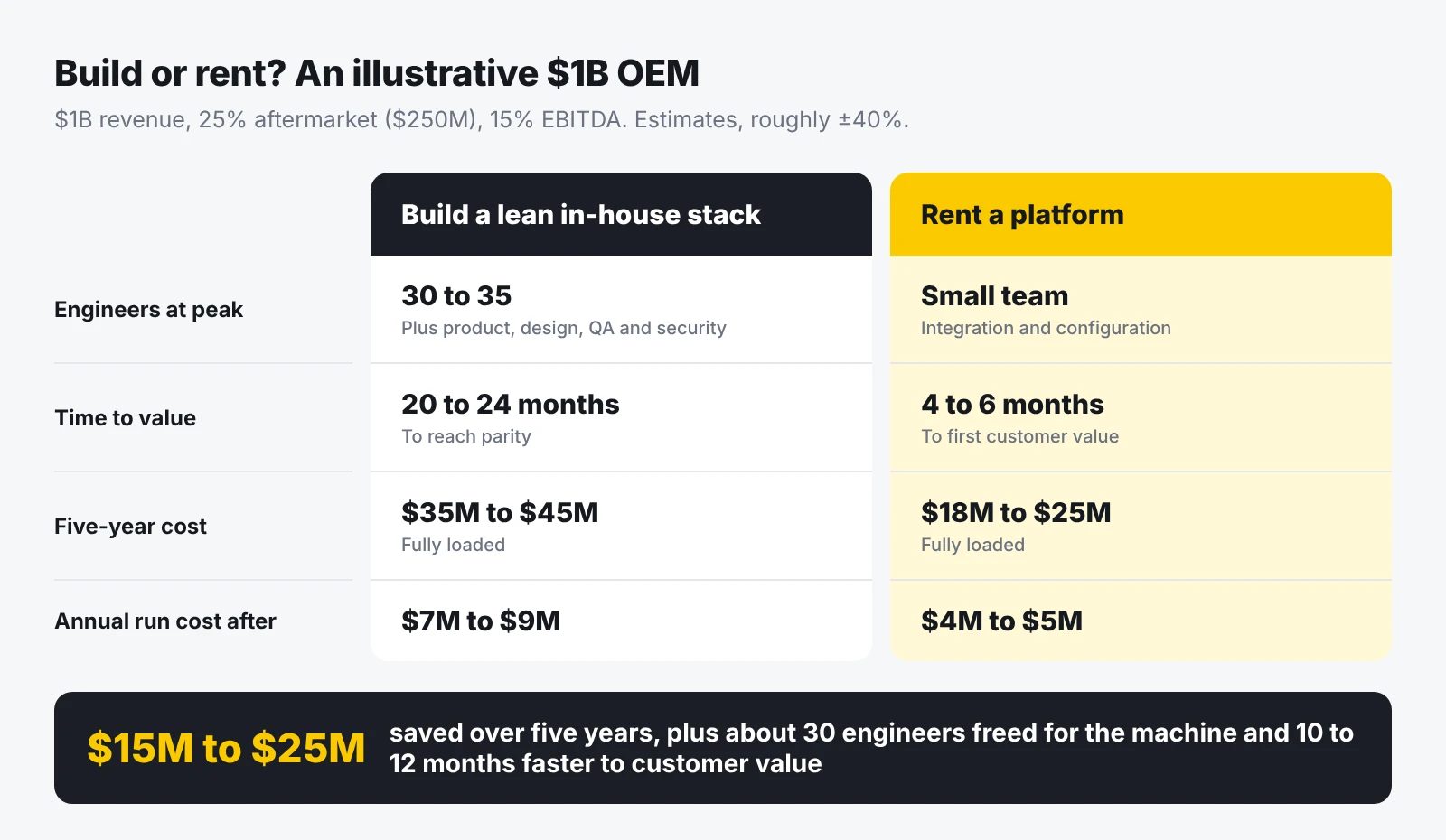
Build vs rent for aftermarket software. The in-house figure includes security, support, integrations, change management and contingency. A fully loaded US software engineer typically costs 1.25 to 1.4 times base salary, roughly $200,000 to $240,000 a year before contractors and tooling.
The gap: $15M to $25M over five years, plus about 30 scarce engineers. Picture those engineers on a more efficient drivetrain, a longer-life component or the analytics behind an uptime-guarantee product.
The cost of delay and why investors care. At an assumed 12x EBITDA multiple, a $4M annual run-cost gap removes roughly $48M in enterprise value. Even larger is the cost of delay: one extra point of aftermarket margin on $250M is $2.5M a year. Delivering that 10 to 12 months sooner captures $2M to $2.5M in profit, roughly $25M to $30M in enterprise value. Just as importantly, the company that ships first collects field data first and launches its uptime contract while a homegrown build is still in integration testing.
One-way or two-way door? Committing 30 engineers to a two-year build is a one-way door. Renting a specialist platform with a tested exit keeps your aftermarket choice a two-way door.
Why aftermarket software is harder than the demo looks
In boardrooms across the industrial sector, directors are asking a fair question: “With AI accelerating software development, why are we paying a specialist vendor?” Every executive leader needs a crisp answer. Rapid prototyping solves the visible interface, while long-term ownership requires mastering the operational layers beneath the surface:
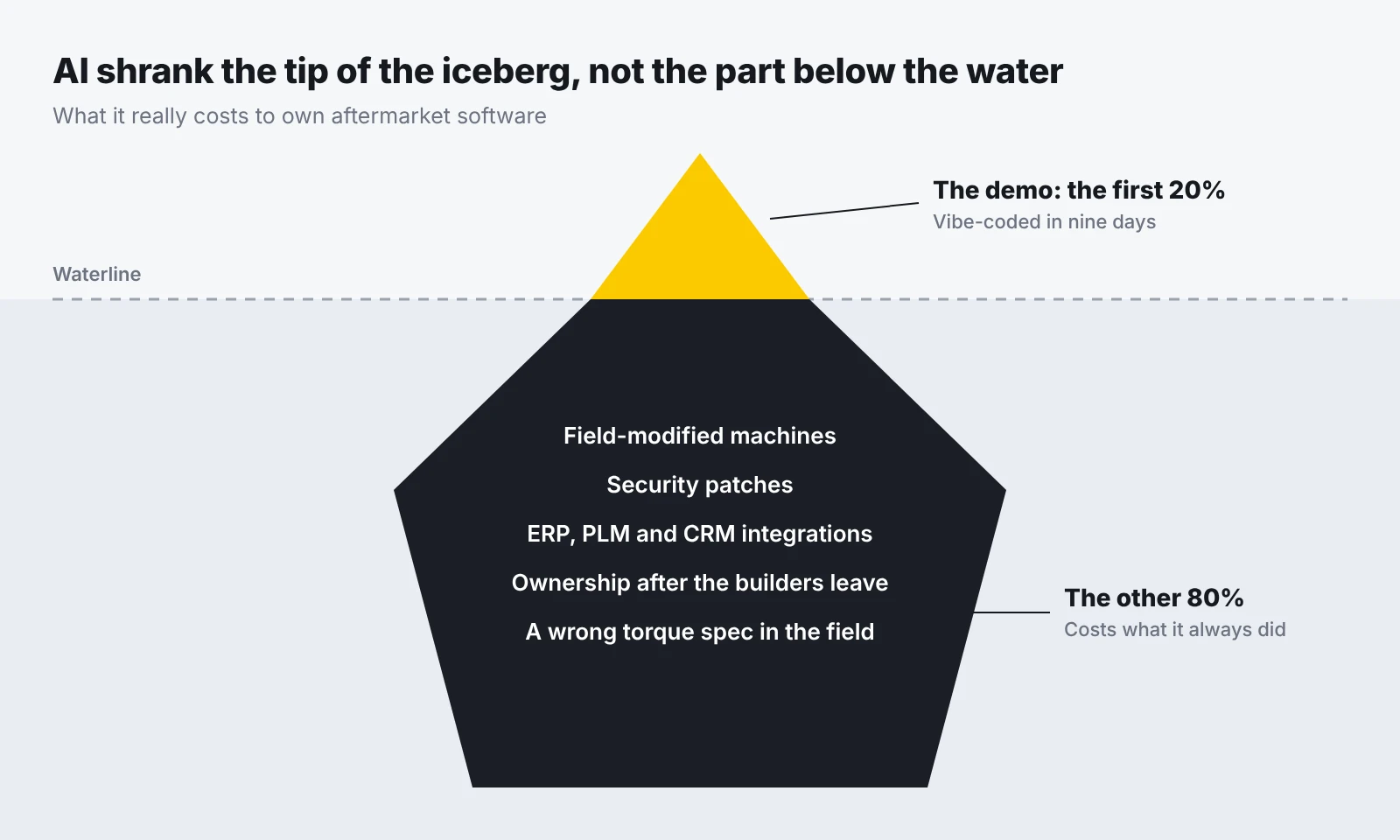
The aftermarket software iceberg: the visible prototype and the decade of production operations.
- The demo-to-production gap. Prototypes rarely account for made-to-order configurations, undocumented 2019 field modifications, offline use in a mine or on a rig, regional dealer pricing tiers and superseded part numbers. For an OEM, those are not edge cases. They are Tuesday.
- Cross-system data hygiene. ERP, PLM and CRM connections evolve with every enterprise upgrade. AI accelerates building the connector, but it does not automatically reconcile decades of fragmented asset master data behind it.
- Lifecycle ownership and key-person continuity. Custom applications built rapidly by a small internal tiger team still require long-term documentation, security patching, model-upgrade testing and dedicated operational staffing when original builders rotate to new priorities.
- Physical safety and liability guardrails. On heavy customer equipment, an inaccurate part number or torque specification is a safety and uptime event. Production deployment demands strict role-based permissions, deterministic guardrails and a verifiable audit trail.
The real value of a specialist partner is cross-industry learning absorbed from hundreds of deployments, paired with the discipline of maintaining and upgrading a mission-critical platform over a decade.
What to demand from any aftermarket software partner
Renting context only works if you keep control of what matters. Whoever you choose, put these in the contract:
Ownership of data and trained models
Your machine data, your customer data and any models trained or fine-tuned on them belong to you, contractually, in a usable export format.
A tested exit
Not a clause, a drill. A documented 90-day exit plan, rehearsed before you need it, with full data and configuration export.
Source code escrow
If the vendor fails, is acquired or abandons the product, you get the code needed to keep running.
Price protections
Caps on renewal increases and clear pricing for AI usage, so a successful rollout does not become a hostage situation.
Outcome-based accountability
Tie fees to measurable results, such as first-time fix rate, parts order accuracy or time to resolution, and keep the right to walk if outcomes are not delivered.
Model-change governance
Advance notice, regression testing and rollback when underlying AI models change behavior.
These terms turn a one-way door into a two-way door. They are the price of renting safely.
Your engineers belong on the machine
Here is the bottom line for industrial leaders. The manufacturers that lose ground over the next decade will not be the ones that picked the wrong ticketing vendor. They will be the ones that spent years and their best engineering talent rebuilding commodity software while competitors turned their installed base into guaranteed-uptime contracts.
AI did not change the Core vs Context test; it made the answer more urgent. As you finalize your 2027 roadmap, audit every internal build proposal against Moore’s framework. Require a funded five-year operating plan for anything you keep in-house, and lock in data ownership and exit rights with your partners.
So go back to that CIO and his nine-day portal. Celebrate the team’s builder energy, and then walk through the day-two operational questions. If the honest answer is “we will own that forever,” make sure forever is spent on something your customers will actually pay for.
Build the machine. Build the business model. Rent the plumbing, and keep the keys.
See what we can unlock with your machine
Give us one representative machine, including its configuration, BOM and documentation. We will show you what Industrility aftermarket software can unlock across parts, service and upgrades.
Pat McCarthy is an enterprise technology executive and an advisor to Industrility. The views in this article are his own.
Want to learn more first? Explore the Industrility aftermarket software platform, read our case studies, see how Industrility works with the Siemens partner ecosystem, or browse more on the Industrility blog.