Loyalty
Frequent-Flyer Miles, Engineered for Machines
The first equipment loyalty program built for machine makers. Dealers and customers earn for the real work they already do, turning maintenance, parts and service into aftermarket revenue.
47
Earning events
~19
Connected apps
3 wallets
One event
The problem
Your Margin Is in Aftersales. Your Customers Are Shopping Elsewhere.
Aftersales is where machine manufacturers make their margin, and where they lose customers to gray-market parts, unauthorized service and competing OEMs. Loyalty makes the authorized channel the obviously better deal.
Parts Bought on Price Alone
The gray market wins the reorder. Points make genuine parts cheaper over time, order after order.
Dealers Chase Margin, Not Relationships
A dealer bonus on the same event pays the channel for the behavior the OEM actually wants.
Customers Go Dark After the Sale
Every PM, order and survey becomes a touchpoint, and the wallet becomes the relationship metric.
The Lock-In Layer
Every other app, from Parts and Maintenance to eCommerce and Warranty, gets more strategic the moment its activity is earning points.
Why it works
Everything Airlines Figured Out, Applied to Equipment
Frequent-flyer programs work because they reward travel you were going to book anyway, and make leaving expensive. The same mechanics apply cleanly to a machine that runs for 10 to 25 years.
Frequent-flyer program
- Miles for flights you were taking anyway
- Elite status unlocks a better earning rate
- The corporate account and the traveler both earn
- Partner airlines earn on the same ticket
- Miles redeem for flights, so spend stays inside the airline
Industrility Loyalty
- Points for maintenance, parts and service you already perform. Nothing to scan, claim or learn.
- Configurable tiers unlock earning multipliers, so the next order is always worth more than the last.
- Company Wallet and User Wallet both credit from a single event: the company and the technician who did the work.
- The dealer on that machine earns a bonus on the same event, without a separate invoice.
- Points redeem for rewards you configure, such as parts credit and free freight, so value recirculates to the OEM instead of leaking out as cash.
Core capabilities
An Equipment Loyalty Program Configured Around Your Channel
You set how members progress, what their points buy and how the program is run. No code, no engineering ticket.
Tiers Built for Your Channel
Name each level, set the points needed to reach it and choose the earning multiplier it unlocks. Members move up the moment they qualify, and status is reviewed once a year.
Track and Manage Points
One dashboard shows active members, points earned and redeemed, redemption rate and every recent transaction. Adjust rules, caps and budgets as the program runs.
Rewards They Value
Pick what points buy for each wallet: parts credit, free freight or service discounts for the company, and gift cards, branded gear or coupon codes for the technician.
See Every Organization at a Glance
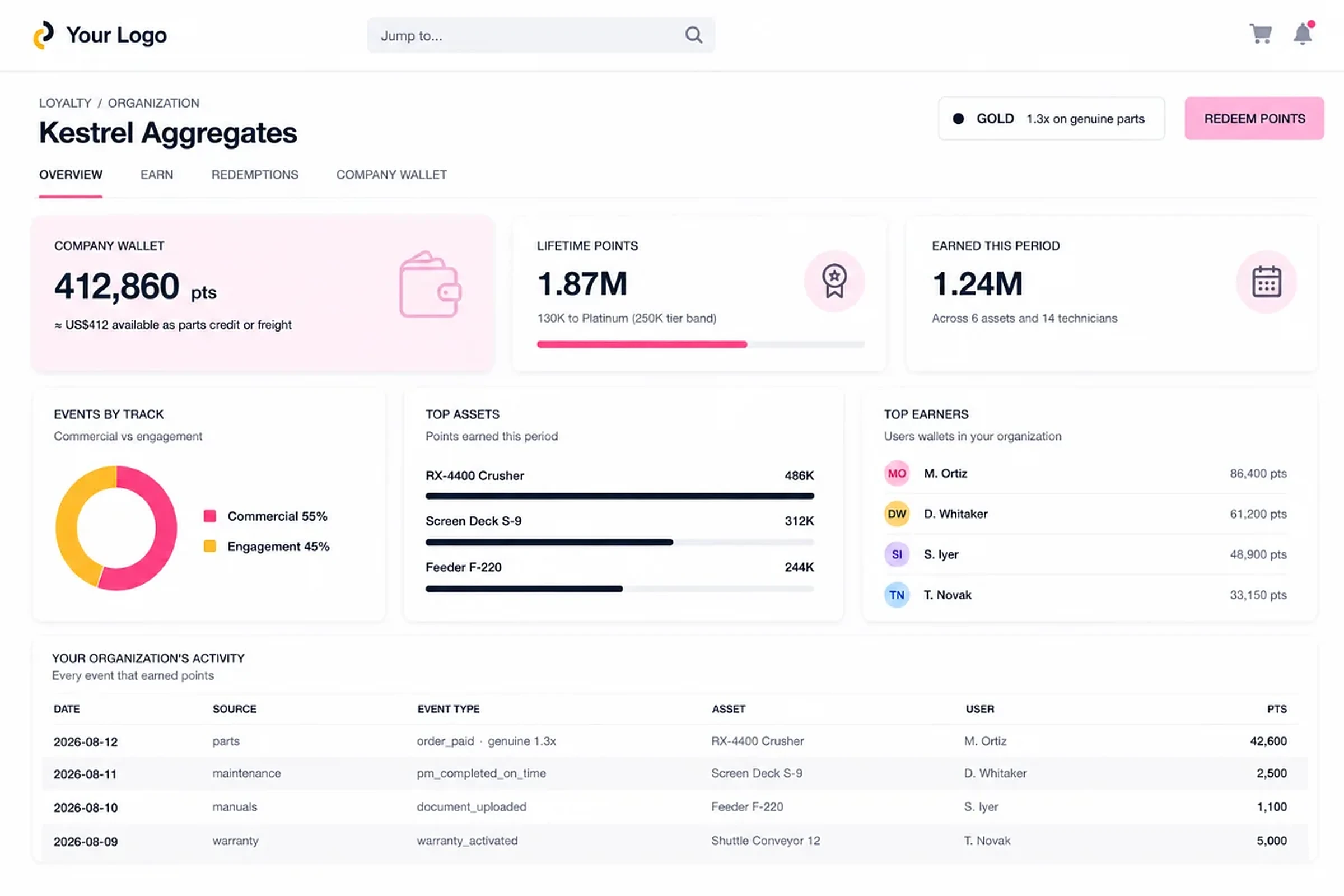
Company admins see their wallet balance and what it is worth in parts credit or freight, progress to the next tier, top assets, top earners and every event that earned points.
What's inside
One Operational Event. Three Parties Rewarded.
An OEM sells through dealers, dealers sell to end customers, and end customers run the machine for decades. A single-balance loyalty app rewards one of them. This routes one event to all three.
Company Wallet: The Company
Owned by the buying organization. Redeems as parts credit, free freight or a service discount.
User Wallet: The Technician
Owned by the person who did the work. Redeems for gift cards, branded gear or coupon codes.
Dealer Wallet: The Distributor
An optional bonus paid on top. Company and user shares are never reduced to fund it.
Configurable split: you decide how each event divides between the Company Wallet and the User Wallet, per program or per earning track. Purchases can reward the organization while work rewards the technician.
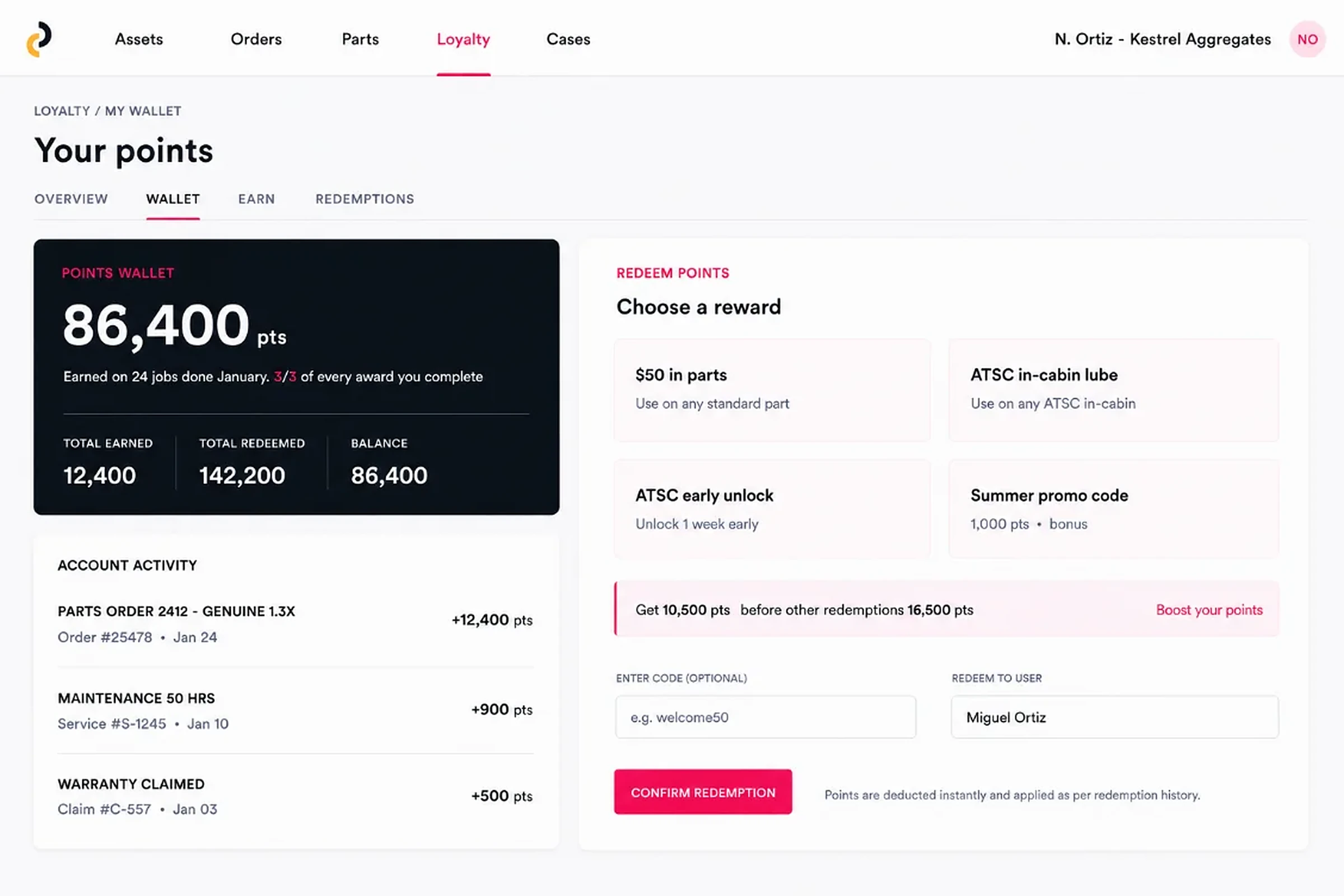
User Wallet
A Wallet Every Technician Can Use
Technicians see their balance, what they have earned and redeemed, and each job that added points. Choosing a reward takes a few clicks, and points are deducted instantly.
How it works
Earning Is Automatic. There Is No "Give Points" Button.
Every qualifying action fires an event on its own: 47 earning events across roughly 19 connected apps, from Assets and Maintenance to Parts, Cases and Manuals.
Commercial events: Earn a Share of Dollar Value
Orders, quotes and opportunities earn a reward rate you set on the amount, hard-capped at 10%, with 1 to 3% recommended.
Engagement events: Earn Flat Points
PM completed, part installed, warranty activated, contract renewed, survey submitted, profile filled in.
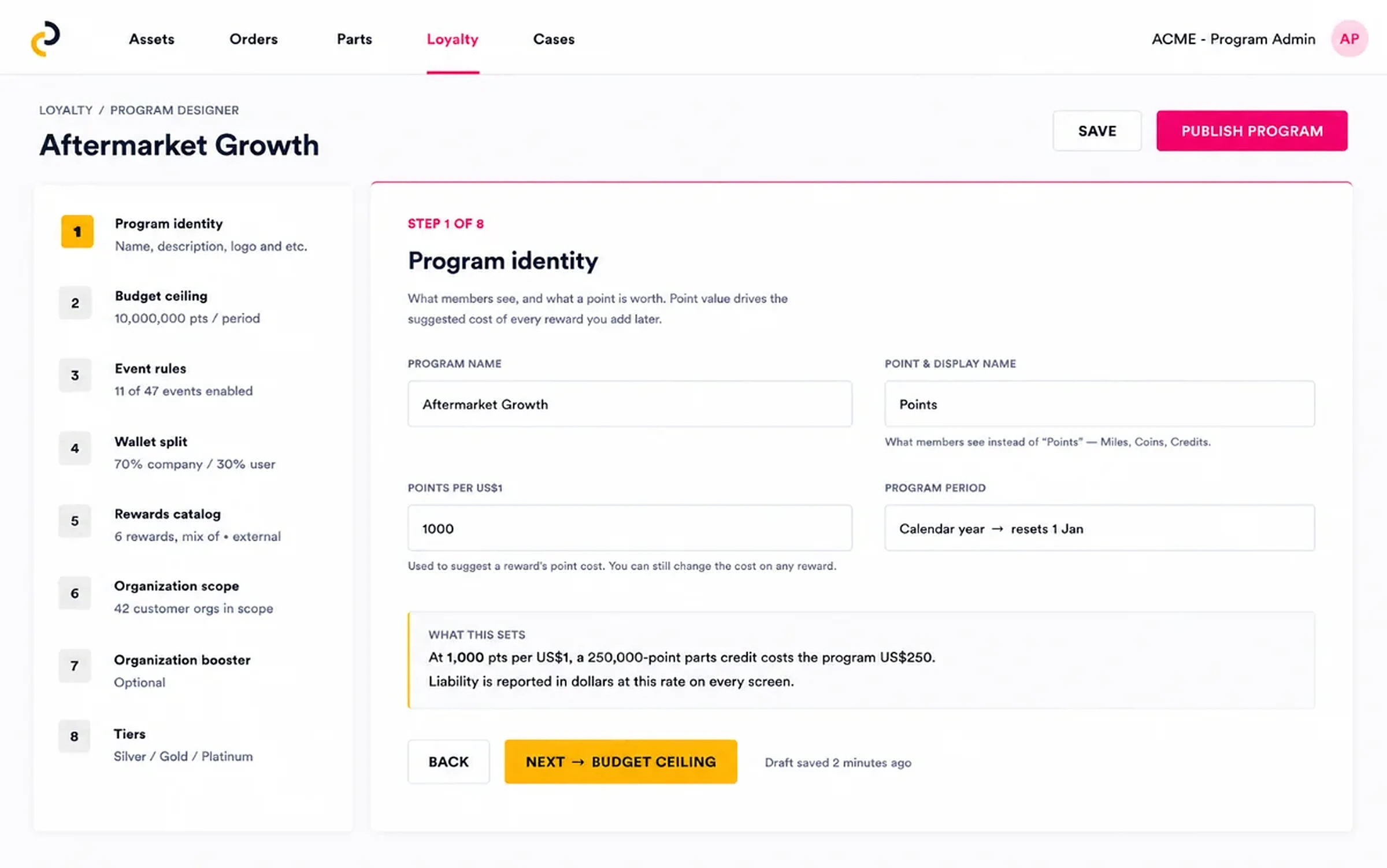
Program Designer
Publish a Program in Eight Steps
Set the program name, point value and period, then the budget ceiling, event rules, wallet split, rewards, organization scope, booster and tiers. Drafts save as you go.
Like a Frequent-Flyer Program, for Equipment
Pull aftermarket revenue back, reward the whole channel and build operational habits, with a provable, capped ROI. Publish a working program in minutes.
Frequently Asked Questions About Equipment Loyalty
1. Our procurement customers have strict anti-incentive policies. Can we still run a program?
Yes, with one program. Turn User Wallet Earn off and every point routes to the Company Wallet, so operators never see a personal balance. Or leave earning on and turn User Wallet Redeem off, so points work as recognition but cannot be converted to value. Combined with a configurable split, where purchases reward the organization and work rewards the technician, one program serves commercial, public-sector and healthcare accounts alike.
2. What stops points being farmed, or the budget running away?
Three independent controls: per-rule caps by user or asset and by day, week, month or lifetime; a program budget ceiling that stops issuance until the next period, leaving existing balances untouched; and a 10% ceiling on commercial reward rates.
3. How do you stop points landing in the wrong organization's wallet?
Two automatic gates. Program scope skips events from out-of-scope organizations. Actor-in-org requires the acting user to belong to the asset’s owning customer org, so an OEM technician servicing a machine does not deposit points into that customer’s wallet. Unattributed system events credit the org via the Pool Wallet.
4. Is this just paying customers to buy more?
No, and the framing matters. The program rewards uptime behavior, not spend alone: on-time preventive maintenance, warranty activation, inspections and contract renewals all earn without a dollar amount attached. The message to a customer is that you are invested in their plant’s uptime and performance, not that they should buy more to earn more.