Why Technicians Keep Returning for the Same Repair: First-Time Fix Rate Explained
Most service organizations know the problem by feel before they measure it. A technician closes a job, the ticket gets marked complete, and three days later the customer calls again. The machine is down for the same reason. A second visit gets scheduled. The cycle repeats.
The industry term for this is First-Time Fix Rate (FTFR): the percentage of service visits resolved completely on the first attempt, without a return trip. It is one of the most closely watched metrics in field service because it sits at the intersection of direct cost, customer trust, and technician morale. For industrial OEMs managing complex equipment across a dispersed installed base, it is also one of the hardest to move.
This article breaks down what FTFR actually measures, why the problem is structurally worse for industrial OEMs than for general field service, and what a practical improvement path looks like.
What First-Time Fix Rate Actually Measures (and Where Most Organizations Measure It Wrong)

According to Aberdeen Group data, the average first-time fix rate across field service companies sits at approximately 75%, with best-in-class organizations reaching around 89%. It typically takes 1.6 additional visits to fully close a job that was not resolved the first time. Most published benchmarks cluster between 70% and 85% for average performers, with top performers consistently above that range.
Industrial equipment shifts the baseline. Across manufacturing and energy equipment sectors, a rate near 70% can still represent solid performance. For simpler service categories, anything below 80% signals inefficiency. Equipment complexity moves the benchmark, not technician effort.
The measurement trap most organizations fall into is counting a job as fixed the moment the ticket closes, even when the customer calls back the following week. Mature service teams measure actual customer resolution rather than administrative closure. If your FTFR looks healthy on a dashboard but customers are consistently calling back, the metric is measuring the wrong thing.
The Real Cost of a Repeat Visit Extends Well Beyond the Second Truck Roll
Every additional visit carries a second labor cost, a second travel expense, and often a second parts shipment against a job already invoiced once. At an average of 1.6 extra visits per unresolved job, that arithmetic compounds quickly across a service organization handling thousands of work orders annually.
For industrial OEMs, the cost shows up in three distinct places. First, direct cost: labor, travel, and expedited shipping for the return visit. Second, contract economics: fixed-price service agreements turn every repeat visit into pure margin loss. Third, trust cost: a customer whose machine has been down twice for the same issue starts questioning whether the service organization actually understands their equipment. That perception affects contract renewals far more than any individual invoice.
The deeper issue is that the technician arriving for the second visit typically has no visibility into what the first technician found. Without access to serial-number-specific service history, every visit starts from zero. This is the installed base visibility gap that Industrility’s Field Service tools are built to close, connecting machine-level history to every technician interaction rather than leaving each visit isolated from the last.
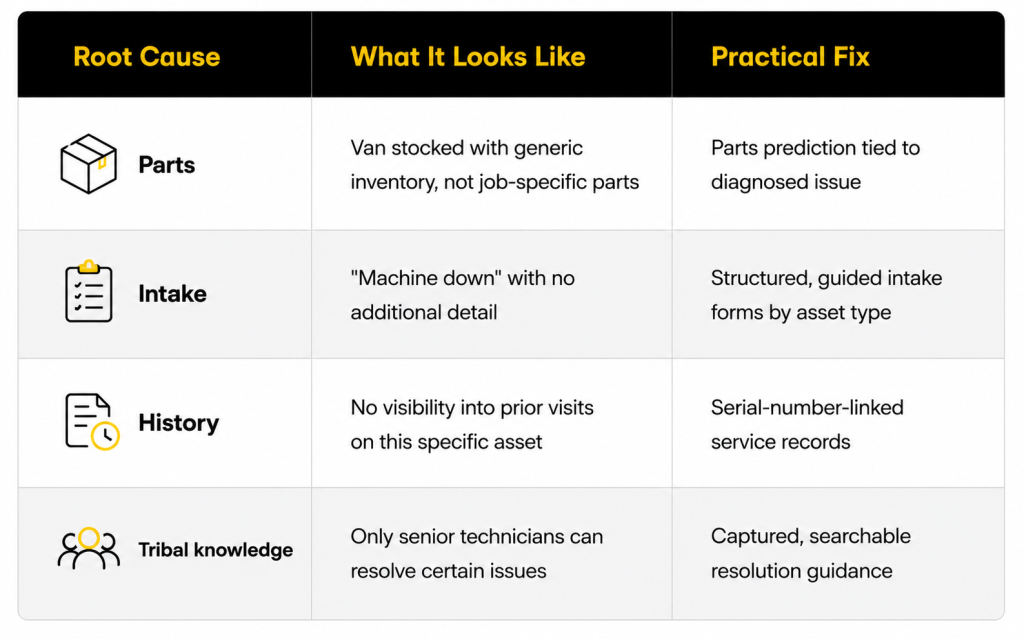
The Four Root Causes Behind Repeat Repairs in Industrial Settings
The same failure patterns appear consistently across industries, regardless of equipment type or technician experience level.
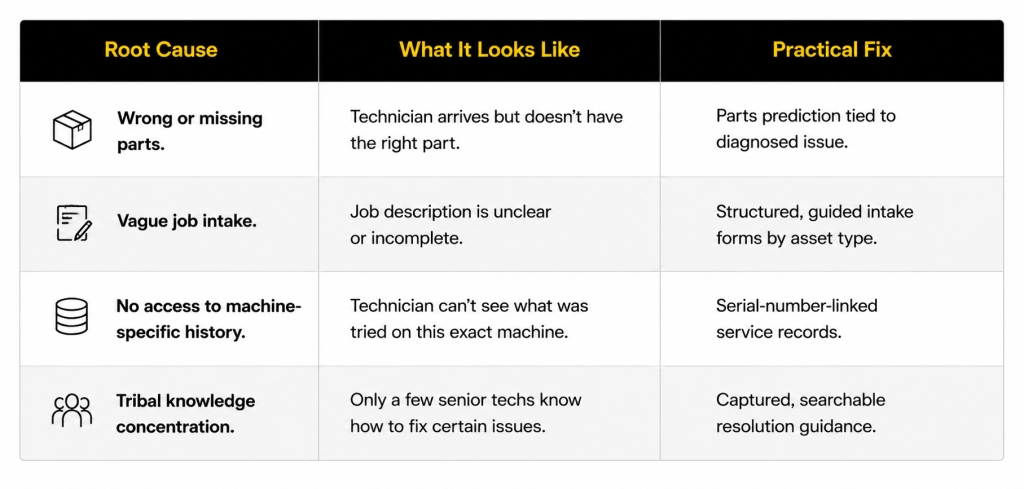
Wrong or missing parts. A technician who arrives ready to work but cannot complete the repair because the correct part is not in the van is not facing a skills failure. It is a parts failure. Compounding this, research from field service analytics firms indicates that approximately 35% of replacement parts are later found to have been perfectly functional. The technician replaced the wrong component because the diagnosis failed, not because the repair did.
Vague job intake. Job intake has historically been unstructured. A customer describes a problem in plain language, a coordinator logs it in shorthand, and “unit not working” becomes the entire description a technician has to work from. A technician dispatched against a one-line description is diagnosing from scratch before they even arrive on site.
No access to machine-specific service history. When a technician cannot see what was attempted on this exact serial number during the previous visit, they re-diagnose from the beginning and often repeat the same incorrect fix. The problem is not knowledge, it is access.
Tribal knowledge concentration. When only a handful of senior technicians understand how to resolve certain failure patterns, everyone else is estimating. This is the same workforce knowledge-loss dynamic driving concern across industrial sectors as experienced workforces approach retirement age.
Why Industrial OEM Service Faces a Harder Version of This Problem
Most published content on First-Time Fix Rate is written for HVAC contractors, appliance repair, and automotive service, where failure modes are relatively standardized and parts compatibility is predictable. Industrial OEM service operates in a different environment entirely.
A single product line can carry dozens of configurations, each with different part compatibility and revision histories. Operations and maintenance manuals for complex industrial equipment often run hundreds of pages, with critical maintenance procedures buried in dense, inconsistent formatting across multiple source documents. Machines are scattered across customer sites, dealer networks, and regions, often with incomplete or siloed records of what is actually installed and what work has been performed. A technician may be servicing a 15-year-old machine using documentation that predates the current service team entirely.
This is precisely the gap that AI-guided maintenance intelligence is designed to close: surfacing the failure patterns and maintenance tasks buried in OEM documentation that a technician working from memory or a static manual would otherwise miss.
How to Actually Improve First-Time Fix Rate
There is no single intervention that moves FTFR reliably. Improvement is a chain, and it breaks wherever the weakest link sits.
Structure the intake. Replace free-text job descriptions with guided questions specific to the asset type and reported symptom. The diagnosis starts before the technician leaves the depot.
Connect service history to the serial number. Every technician should see what has already been attempted on this exact machine, not just this product line. History at the asset level is what prevents the same wrong fix from being repeated.
Guide the diagnosis, not just the repair. AI-guided troubleshooting that reasons from actual case history and machine-level data reduces the guesswork that leads to unnecessary parts replacement. Industrility TwinGPT AI Agents support exactly this workflow: structured diagnostic guidance at the point of service, built from the OEM’s own documentation and service history.
Predict the parts before dispatch. AI-powered parts prediction that draws from service records, bills of materials, and warranty data can meaningfully lift FTFR for organizations that have already plateaued despite other investments. One organization applying resolution intelligence to parts decisions improved the share of work orders requiring no parts at all from 31% to 44%, direct evidence that better diagnostics rather than more inventory was the actual fix.
Close the loop on every visit. Every resolved and unresolved visit should feed back into the knowledge base. The next technician, regardless of experience level, should start from where the previous one left off rather than from zero.
When Additional Training Is Not the Answer
Reach for training when the gap is genuinely a skills gap: new hires who have not yet built pattern recognition for common failure modes, or a new product line the whole team is encountering for the first time.
Do not reach for training when experienced technicians are missing first fixes at the same rate as newer hires. If your most capable people are having the same problem as someone in their first year, the issue is not knowledge inside someone’s head. It is information they cannot access at the moment they need it. No additional training fixes a van missing the right part or a job ticket that did not describe the actual fault.
The fastest diagnostic: check whether repeat visits cluster around specific technicians (a skills signal) or around specific machines, parts, or job types regardless of who is dispatched (a data signal). The answer tells you where to invest.
See what your service operation looks like when technicians have the full picture before they arrive.
Industrility connects machine-level service history, AI-guided diagnostics, and parts prediction in one platform built specifically for industrial OEMs. Talk to Industrility about Field Service or explore how TwinGPT AI Agents guide technicians to the right fix on the first try.
Frequently Asked Questions
What is a good First-Time Fix Rate?
Generally 75% to 85% for standard field service, with best-in-class organizations reaching 89% or above. For complex industrial machinery, rates closer to 70% can still represent strong performance given the diagnostic complexity involved.
Why is our First-Time Fix Rate low even though our technicians are experienced?
Experienced technicians missing first fixes is almost always a sign of a data or logistics problem: missing parts, incomplete job history, or vague intake. It is not a skills problem. If your best technicians and your newest hires are failing at the same rate, the constraint is information access, not expertise.
What is the difference between First-Time Fix Rate and Mean Time to Repair?
FTFR measures whether a job was fully resolved on the first visit. Mean Time to Repair (MTTR) measures how long repairs take overall, including return visits. A team can have a fast MTTR and still have a poor FTFR if repeat visits are common but short.
How does AI improve First-Time Fix Rate?
By connecting diagnosis to actual service history and parts data at the point of service, AI reduces guesswork in both identifying the fault and selecting the correct component. This directly addresses the two most common root causes of repeat visits.
Should we track FTFR per technician or per asset type?
Both, but separately. Clustering by technician points to a skills gap. Clustering by asset type, part number, or job category points to a data or documentation gap. The pattern tells you where to focus the fix.