Beyond the Parts Catalog: The Rise of Asset-Centric Aftermarket Platforms
Digitizing manuals into searchable parts catalogs is largely a solved problem. The harder, more valuable question is whether your platform simply publishes information about your equipment, or actually understands every machine you have in the field. That line is what now separates established catalog platforms like Documoto from a newer, asset-first class of platform.
For most equipment manufacturers, leasing firms and tier-1 suppliers, the first wave of aftermarket digitization is finished. Paper manuals became searchable. Exploded diagrams moved online. Dealers stopped faxing part numbers. Platforms like Documoto, Quanos and others earned their place by doing that job well and at scale.
But the value has moved. The next competitive frontier is not publishing content about equipment. It is operating an intelligent service layer that knows what each specific asset is, what is inside it, how it is being used, and what it is about to need. This article compares the two approaches honestly, with verified facts, so you can decide which fits your business.

The Installed Asset Base as a Sustainability Lever for OEMs
Every OEM has an installed base. It is the full population of equipment they have sold that is currently operating in the field. For most OEMs, this base represents years or decades of engineering investment and customer relationships. It is also the most underutilized sustainability asset in the business.
The core insight is simple. Every decision that extends the life of an installed asset, improves its uptime, or prevents an unnecessary replacement is a direct sustainability win. Keeping a piece of equipment running for two extra years avoids all the materials, energy, and emissions that a replacement would require. Eliminating three unnecessary service visits per month across a large fleet removes real fuel consumption from the equation.
The challenge is that most OEMs lack the data foundation to make these decisions well. Asset information sits across ERP systems, CRM platforms, engineering databases, spreadsheets, and the collective memory of experienced technicians. When someone needs to decide whether to repair or replace a specific asset, the answers are hard to find and often incomplete.
This fragmentation is not just an IT problem. It is a sustainability problem. Without accurate asset intelligence, OEMs default to assumptions. Assumptions tend to favor the conservative, wasteful choice: replace rather than repair, dispatch rather than triage remotely, overstock rather than optimize.
Industrility’s Installed Base Intelligence solution solves this directly. It creates a single, continuously updated source of truth for every installed asset, giving OEMs the visibility they need to make smarter lifecycle decisions.
1. Why aftermarket is the prize
Before comparing platforms, it is worth being clear about the money on the table, because it justifies the investment in either approach. Aftermarket service is not a cost center to be tidied up. It is structurally the most profitable, most resilient part of an equipment business.
McKinsey’s analysis across 30 industries found that the average EBIT margin for aftermarket services was roughly 25 percent, against about 10 percent for new equipment. Separate McKinsey research argues that manufacturers who get serious about it can grow services revenue by 30 to 60 percent within three to five years. On the cost side, Deloitte estimates unplanned downtime costs industrial manufacturers tens of billions of dollars each year, with predictive-maintenance pilots cutting unplanned downtime dramatically.
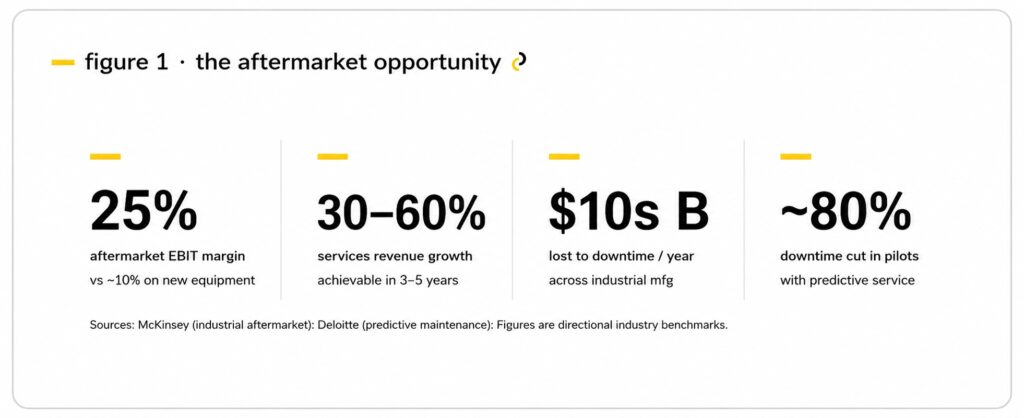
The economics are the reason this category exists. Both catalog-first and asset-first platforms are competing for a share of the most profitable revenue an OEM has.
2. Two operating models, not two feature lists
The most common mistake buyers make is comparing platforms feature by feature. That misses the real fork in the road. The two platforms are built on different assumptions about what an aftermarket system is for.
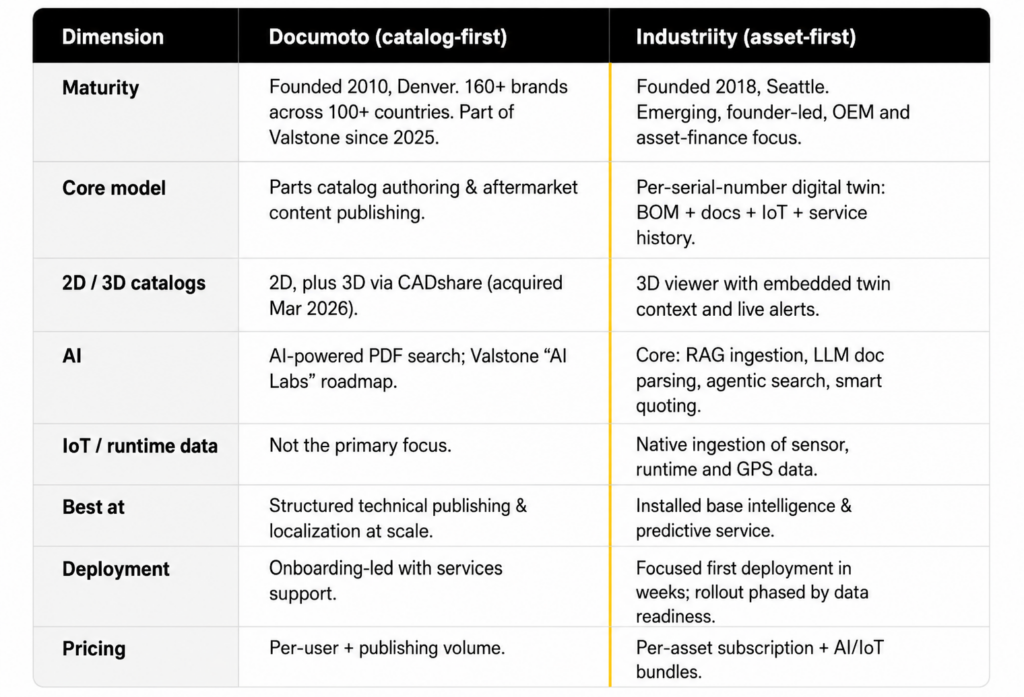
A catalog-first platform like Documoto treats content as the unit of work. Its job is to take engineering and parts data and publish it into clean, searchable, localized catalogs and manuals that dealers and technicians can use. It is excellent at structure, version control and technical publishing at scale.
An asset-first platform like Industrility treats the individual machine as the unit of work. Its job is to maintain a live, serial-number-specific model of every asset in the field, fusing its BOM, documents, sensor data and service history, so that parts, service and predictions all flow from one source of truth.
They can also plan more deliberately for remanufacturing and reuse, recovering value from parts that would otherwise be scrapped. This aligns directly with circular economy principles, as outlined in the Ellen MacArthur Foundation’s framework for industrial circularity.
Industrility’s Parts Commerce platform supports this by connecting parts data directly to asset history, enabling smarter procurement and reuse decisions.
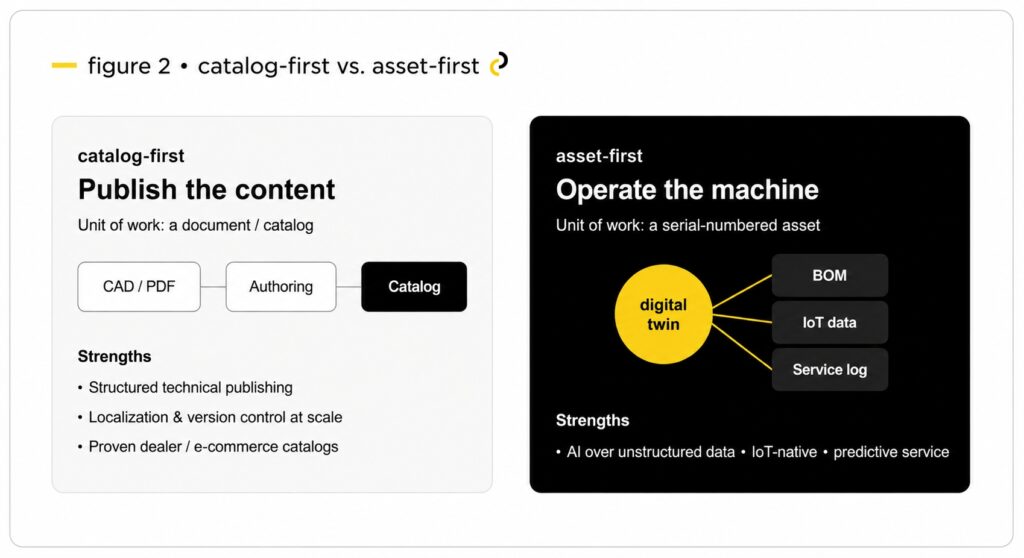
Same industry, different center of gravity. One platform is organized around content; the other around the asset itself. This is the decision that actually matters.
3. What “asset-centric” actually means
“Digital twin” is an overused phrase, so here is the concrete version. In an asset-first model, every machine you have sold or leased exists as a structured object with layers: the equipment, its subassemblies, the individual parts, the sensors reporting on it, and the documents attached to each level. Critically, this is tied to the specific serial number, not a generic product family.
That distinction is the whole game. A catalog tells you what parts a model theoretically contains. An asset-centric twin tells you what is actually installed on unit #4471 today, what it has been through, and the difference between how it left the factory (“as-built”) and how it stands after years of field repairs (“as-maintained”). You can explore how Industrility models this on the digital twin platform page.
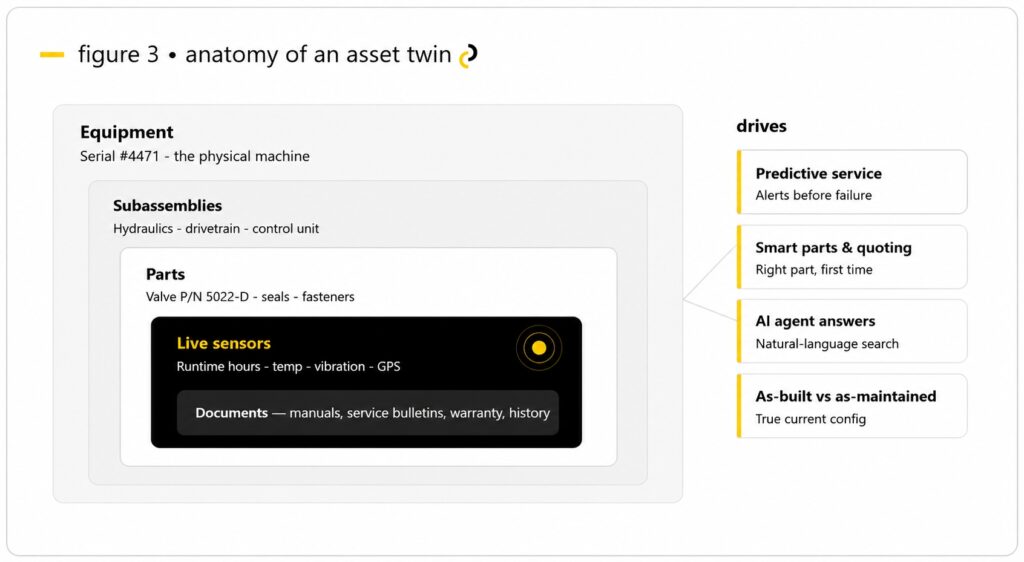
One serial number, fully described. When the live sensor layer feeds the model, the platform stops being a library and starts being an operating system for service.
The natural-language shift
This structure is what makes conversational search useful rather than gimmicky. Instead of drilling through tag trees to find “P/N 5022-D,” a technician can ask in plain language: “The valve assembly on unit 4471 failed twice last quarter; give me the part number and a step-by-step maintenance checklist.” The answer is grounded in that asset’s real history, not a generic manual.
4. An honest, current comparison
Comparisons age badly, so here is the state of play as of mid-2026, with the important update most older comparisons miss: in March 2026, Documoto acquired CADshare and now offers both 2D and 3D interactive parts catalogs, and it has begun rolling out AI-powered PDF search. Anyone who tells you Documoto is “2D only” or “has no AI” is working from outdated information. The real difference is architectural.
5. How to choose
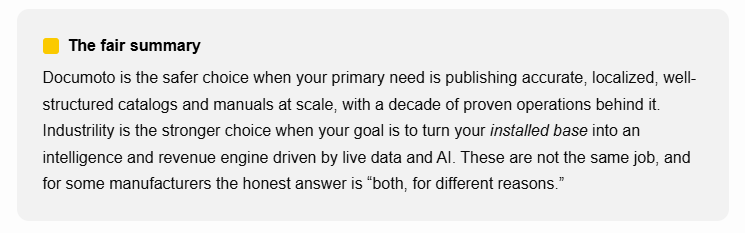
Skip the feature checklist. The decision comes down to where your bottleneck is. If your dealers and technicians cannot find accurate published information, you have a content problem. If you cannot answer “what is the real state of the machines we have in the field, and what will they need next,” you have an asset intelligence problem. Most platforms solve one well.
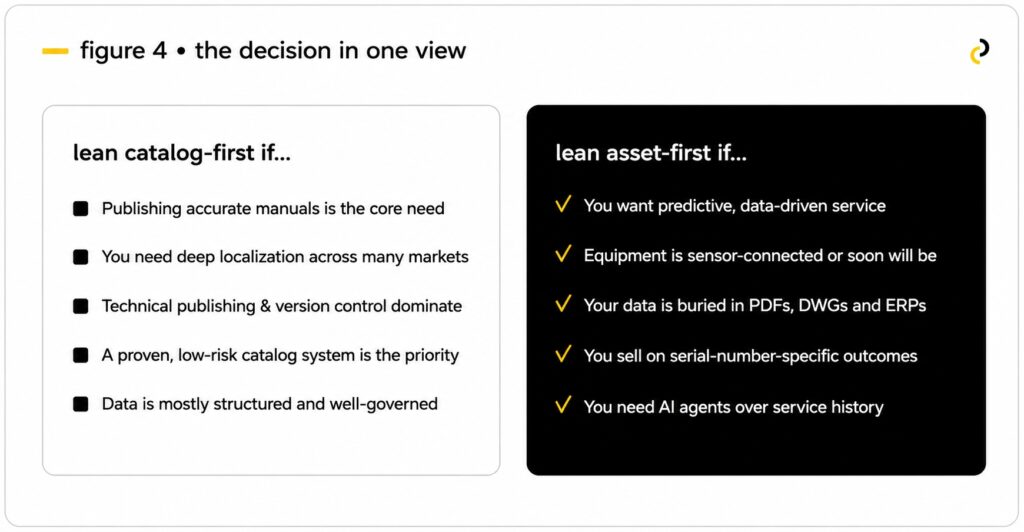
If both lists describe you, you are exactly the kind of operation that runs a publishing platform and an asset-intelligence layer side by side. See where Industrility fits on the platform overview.
A pragmatic path
You do not have to rip anything out to start. Because asset-first platforms are built API-native and modular, a sensible first move is to stand up a digital twin for one high-value asset class, connect its data, and prove the service and quoting upside before expanding. That is the fastest way to a real result, and it sidesteps the all-or-nothing migration that scares most teams off. Read more on the installed base intelligence approach.
See how Industrility turns your installed base into a live, serial-number-specific digital twin that drives parts, service and predictive revenue.