Move Beyond Email Chaos: AI-Powered Case Management for Industrial Manufacturers
Behind every “the line stopped this morning” email is a customer losing production, an agent hunting for context, and an aftermarket relationship quietly being tested. Yet most support still runs on shared inboxes, spreadsheets, and disconnected phone lines, places where customers repeat themselves, serial numbers vanish, and nobody can say how long a case has been open.
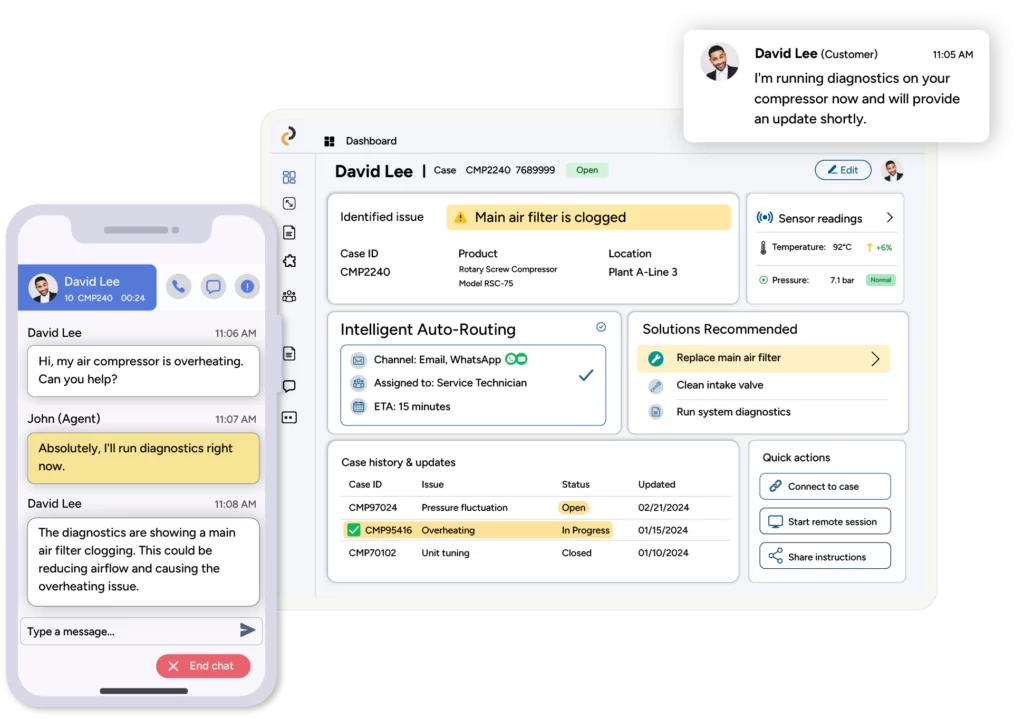
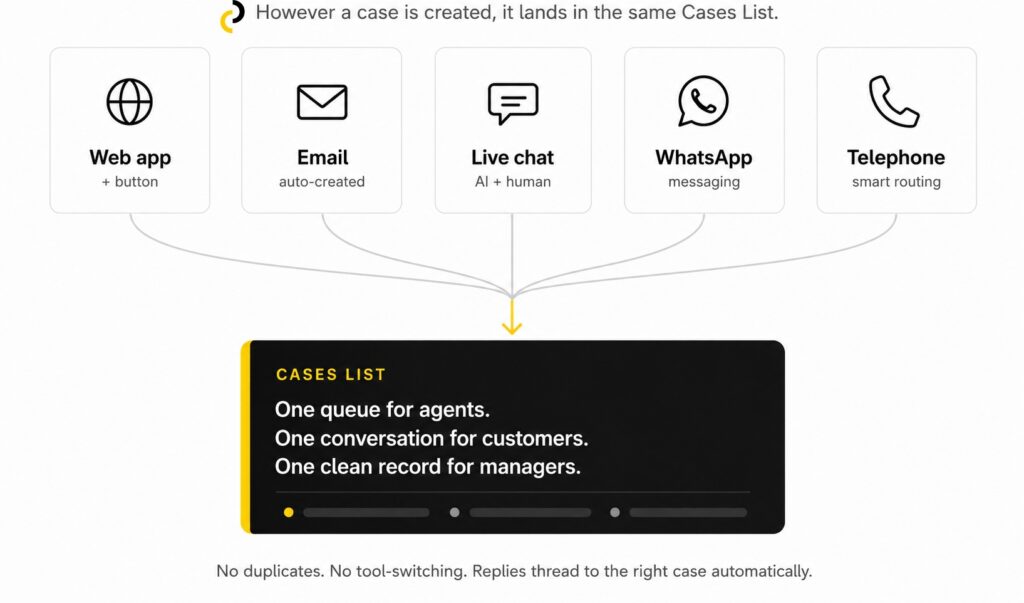
Industrility’s Cases application closes that gap. It’s an AI-integrated case management system built for industrial service teams. Customers open a case by web app, email, live chat, WhatsApp, or phone, and every one lands in the same unified workspace.
The moment a case is created, AI reads the attachments, pulls out error codes and serial numbers, sets a priority, writes a summary, and suggests a fix. Your agent opens a case that’s already understood, not a blank form to investigate. Here’s how it works, and why it makes support faster, more traceable, and ready to scale with your installed base.
One Workspace, Every Channel
The Real Problem: Support that does not Scale
As your installed base grows, so does support volume, but capacity rarely keeps up affordably. The strain shows up fast: too many doors (an email to one engineer, a call for the urgent stuff, a web form for the rest, each channel its own black hole); detective work over fixing, as agents burn time reconstructing which machine, which site, and what was already tried; customers repeating themselves whenever a request jumps from chat to human or phone to email; and leadership flying blind, with no reliable way to know how many cases are open, how many are critical, or where they get stuck.
For a manufacturer building recurring revenue on service contracts and uptime guarantees, these aren’t customer-service annoyances. They’re business problems that erode aftermarket profitability.
Phone is what customers reach for when something’s urgent and expensive. Industrility builds the telephone channel for the cloud, so calls become first-class cases with elastic scale and none of the cost or rigidity of legacy PBX systems. Intelligent skill- and priority-based routing sends each caller to the right agent, IVR self-service handles navigation and authentication up front, and calls are recorded and encrypted for compliance and QA with real-time supervisor monitoring.
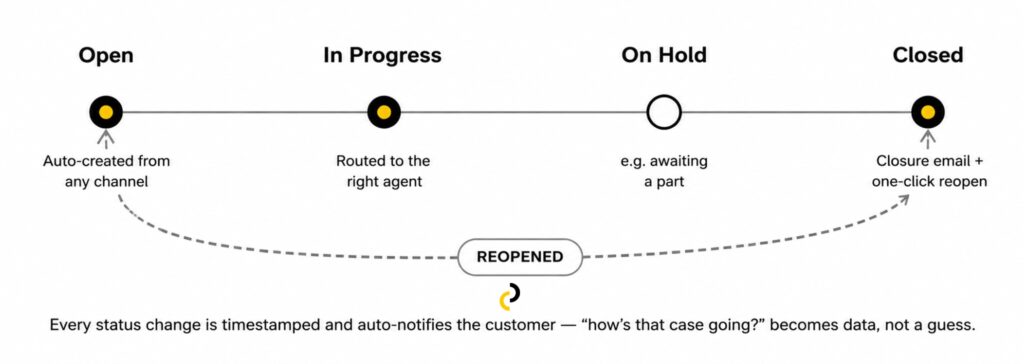
Every case then moves through a clear lifecycle: Open, In Progress, On Hold, Closed, with Reopened if a customer returns. Each status change auto-notifies the customer and is timestamped, so “how’s that case going?” becomes data, not a guess. Manager dashboards read queue health at a glance across Status, Priority, and Type, while recurring case types reveal which issues happen most, intelligence that feeds design improvements and proactive outreach. Pair Cases with TwinGPT and remote monitoring, and support stops being a cost center and becomes a window into your installed base.
AI That Does the Setup For You
The biggest day-to-day change happens automatically the instant a case is created. Before a human touches it, AI reads images and attachments (analyzing equipment photos, running OCR on PDFs, and flagging error codes), parses the description for key facts and urgency, and autofills the fields: Case Type, Priority, Tags, Summary, Asset Serial Number, System ID, and Organization. It writes a one- or two-sentence summary so agents grasp the issue at a glance, then suggests resolutions by surfacing relevant knowledge base articles, similar past cases, and troubleshooting steps.
A Concrete Example
A facilities supervisor calls in a panic and follows up by email: “Compressor unit SN-CMP-20250118 keeps tripping its overload relay. We’ve reset it twice and it shut down again within the hour. Plant B, packaging cell 3. Logs and a thermal photo attached.”
Before an agent reads a word, the AI spots the repeat-failure pattern and sets Priority: High, extracts the serial number as the Asset Serial Number, maps Plant B to the System ID, runs OCR on the log to pull overload fault codes and timestamps, and reads the thermal image to flag an abnormal heat signature near the motor windings. It writes the summary “Compressor repeatedly tripping overload relay; thermal data suggests motor winding overheating” and tags it compressor-fault, recurring-issue, overheating.
The agent opens a complete, correctly prioritized case, not a vague alarm. Five-second triage instead of five-minute triage, on every case, for compressor and generator manufacturers and beyond.
Chat and WhatsApp: Instant AI Help, Human Safety Net
A customer starts a chat or sends a WhatsApp message, and an AI chatbot handles the first line. It answers in real time, walks through troubleshooting from your knowledge base, and remembers the conversation. Because it draws on the same intelligence layer (your docs, your past cases, your FAQs), its answers reflect your equipment, not generic advice. And it’s on 24/7.
When the AI can’t resolve it, escalation is smart, not abrupt. It asks a few targeted questions, auto-creates a case with the full transcript, and routes it to the right agent, who joins the same thread with full history and a pre-filled case in front of them. The customer never repeats themselves.
Telephone, Done Right, and Built to Scale
Phone is what customers reach for when something’s urgent and expensive. Industrility builds the telephone channel for the cloud, so calls become first-class cases with elastic scale and none of the cost or rigidity of legacy PBX systems. Intelligent skill- and priority-based routing sends each caller to the right agent, IVR self-service handles navigation and authentication up front, and calls are recorded and encrypted for compliance and QA with real-time supervisor monitoring.
Every case then moves through a clear lifecycle: Open, In Progress, On Hold, Closed, with Reopened if a customer returns. Each status change auto-notifies the customer and is timestamped, so “how’s that case going?” becomes data, not a guess. Manager dashboards read queue health at a glance across Status, Priority, and Type, while recurring case types reveal which issues happen most, intelligence that feeds design improvements and proactive outreach. Pair Cases with TwinGPT and remote monitoring, and support stops being a cost center and becomes a window into your installed base.
The Real Differentiator: Every Case Tied to an Asset
Here’s what sets Cases apart from a generic help desk: every case is associated with a specific asset or system, not just a customer. That single link changes what your support data can do. Your customers can see the full history of cases raised against a machine, so context travels with the equipment instead of disappearing into someone’s inbox. Your in-house service technicians get pre-visit briefs, what’s failed before, what was tried, and what’s still open, before they ever arrive on site. And because cases are tagged by model, manufacturers can track recurring issues across an entire model line, turning scattered, one-off complaints into a clear signal for design, quality, and maintenance teams.
The analytics build on that same foundation. With detailed reporting on every case, you can see how individual human agents are performing, track turnaround time (TAT), measure customer touchpoints, and steadily raise overall engagement. Support stops being anecdotal and becomes measurable, by asset, by model, by agent, and by outcome.
Quick to Launch
Rollout runs about four weeks: configure email-to-case routing and custom fields, integrate and train the team, pilot with a subset of customers, then launch with dashboards live. With 100+ integrations available, value shows up well before the finish line.
For an equipment manufacturer, support is where your product’s promise meets your customer’s worst day. Handled well, it’s one of the strongest drivers of aftermarket loyalty and recurring revenue you have.
If your support today is scattered across inboxes, phone lines, and spreadsheets that don’t talk to each other, see the alternative. Schedule a demo with Industrility to watch Cases in action.