Why Aftermarket Operations Are the Hidden Frontier of OEM Sustainability

When industrial OEMs discuss sustainability, the conversation almost always starts in the same place: manufacturing. Cleaner production lines. Greener supply chains. Lower-emission facilities. These are worthy goals, and real progress has been made. But a major blind spot remains. It accounts for the majority of a product’s total environmental impact over its lifetime. That blind spot is aftermarket and service operations.
According to research by McKinsey and Company, aftermarket services represent one of the fastest-growing profit pools in industrial manufacturing. Yet most OEMs have barely scratched the surface of their sustainability potential there.
The numbers are striking. For most industrial equipment, between 60 and 80 percent of total lifecycle emissions occur after the asset is installed. Every unnecessary service truck that rolls, every part replaced too soon, every piece of equipment scrapped when it could be refurbished, these are sustainability failures hiding inside everyday decisions. Unlike the manufacturing floor, they have largely escaped the attention of sustainability teams, ESG reports, and executive dashboards.
That is starting to change.
The Real Cost of Reactive Service in OEM Aftermarket Operations
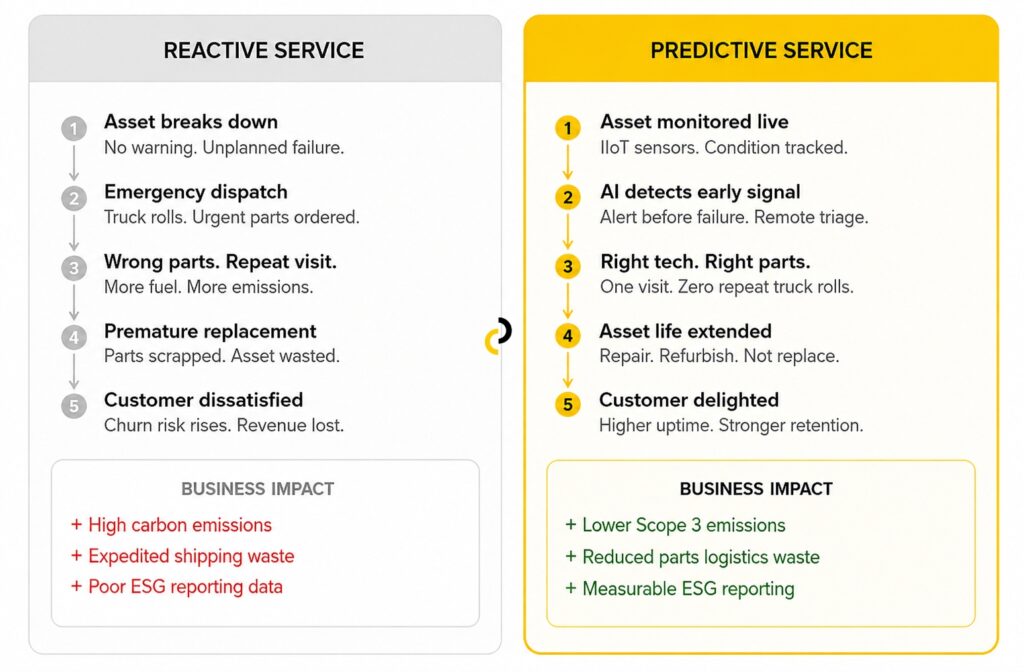
To understand the sustainability problem in aftermarket, you need to understand how most OEM service organizations work. For the majority of companies, service remains reactive. Something breaks, a customer calls, and a technician is dispatched. This model feels normal because it is familiar. It carries enormous hidden costs, both environmental and financial.
Reactive service generates emergency parts orders with expedited shipping. It sends technicians to job sites without the right parts or documentation, forcing repeat visits. It creates unplanned downtime that causes secondary damage and larger repairs. It leads to equipment replacement before the end of its useful life, simply because no one had visibility to intervene earlier.
Multiply this across hundreds of thousands of installed assets, and the scale of the opportunity becomes clear. The inefficiency in reactive aftermarket models is a significant, measurable source of carbon emissions, material waste, and resource consumption.
Industrility’s Field Service platform is purpose-built to help OEMs move away from this reactive cycle. It standardizes work orders, inspections, and checklists to improve first-time fix rates and cut unnecessary truck rolls.
The Installed Asset Base as a Sustainability Lever for OEMs
Every OEM has an installed base. It is the full population of equipment they have sold that is currently operating in the field. For most OEMs, this base represents years or decades of engineering investment and customer relationships. It is also the most underutilized sustainability asset in the business.
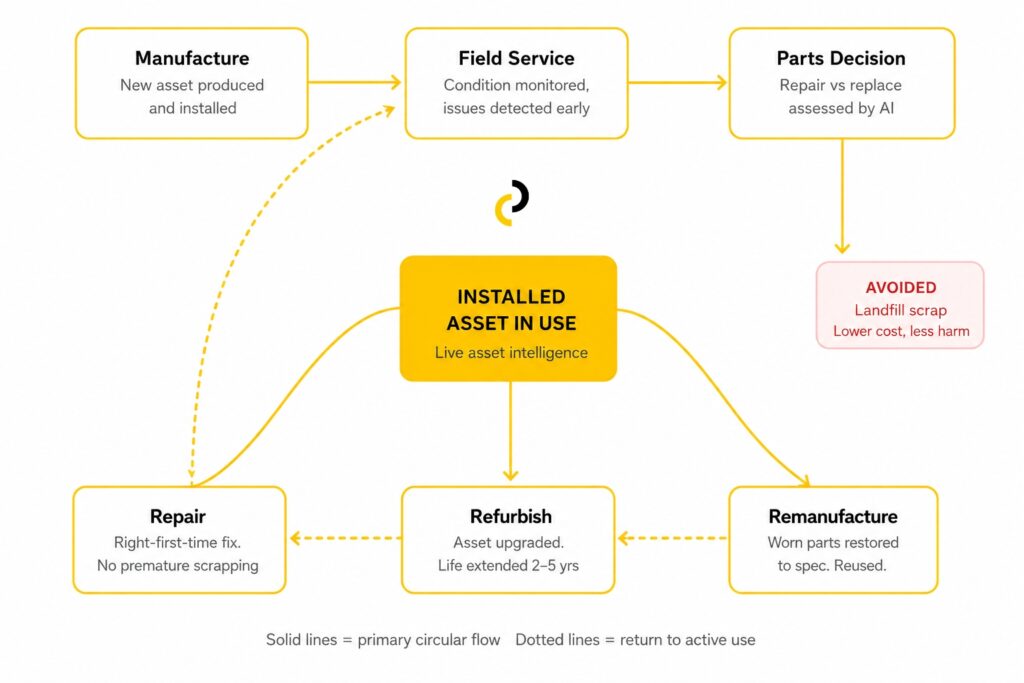
The core insight is simple. Every decision that extends the life of an installed asset, improves its uptime, or prevents an unnecessary replacement is a direct sustainability win. Keeping a piece of equipment running for two extra years avoids all the materials, energy, and emissions that a replacement would require. Eliminating three unnecessary service visits per month across a large fleet removes real fuel consumption from the equation.
The challenge is that most OEMs lack the data foundation to make these decisions well. Asset information sits across ERP systems, CRM platforms, engineering databases, spreadsheets, and the collective memory of experienced technicians. When someone needs to decide whether to repair or replace a specific asset, the answers are hard to find and often incomplete.
This fragmentation is not just an IT problem. It is a sustainability problem. Without accurate asset intelligence, OEMs default to assumptions. Assumptions tend to favor the conservative, wasteful choice: replace rather than repair, dispatch rather than triage remotely, overstock rather than optimize.
Industrility’s Installed Base Intelligence solution solves this directly. It creates a single, continuously updated source of truth for every installed asset, giving OEMs the visibility they need to make smarter lifecycle decisions.
5 Ways Smarter Aftermarket Practices Reduce Environmental Impact
1. Predictive and Condition-Based Service
Condition-based service replaces assumptions with data. Instead of following static, calendar-based schedules, service teams can respond to what is actually happening with specific equipment. The result is fewer unplanned outages, fewer emergency dispatches, and service intervals matched to real asset conditions.
The European Environment Agency has highlighted predictive maintenance as a key enabler of industrial decarbonization, noting its role in reducing both downtime and unnecessary resource consumption.
Industrility’s Remote Monitoring capabilities turn live IIoT sensor data into predictive alerts and service actions. OEMs can trigger the right response at the right time, before failure occurs.
2. Right-First-Time Service Execution
One of the most wasteful patterns in field service is the repeat visit. A technician arrives at a job site without the right parts, or without accurate documentation for the specific asset configuration in front of them. Access to complete, asset-specific service history and technical documentation cuts repeat visits significantly. This reduces fuel consumption, labor hours, and customer frustration in a single step.
Industrility’s Customer Support portal gives technicians and service planners instant access to the right documentation, at the asset level, in real time.
3. Smarter Parts Usage and Inventory Management
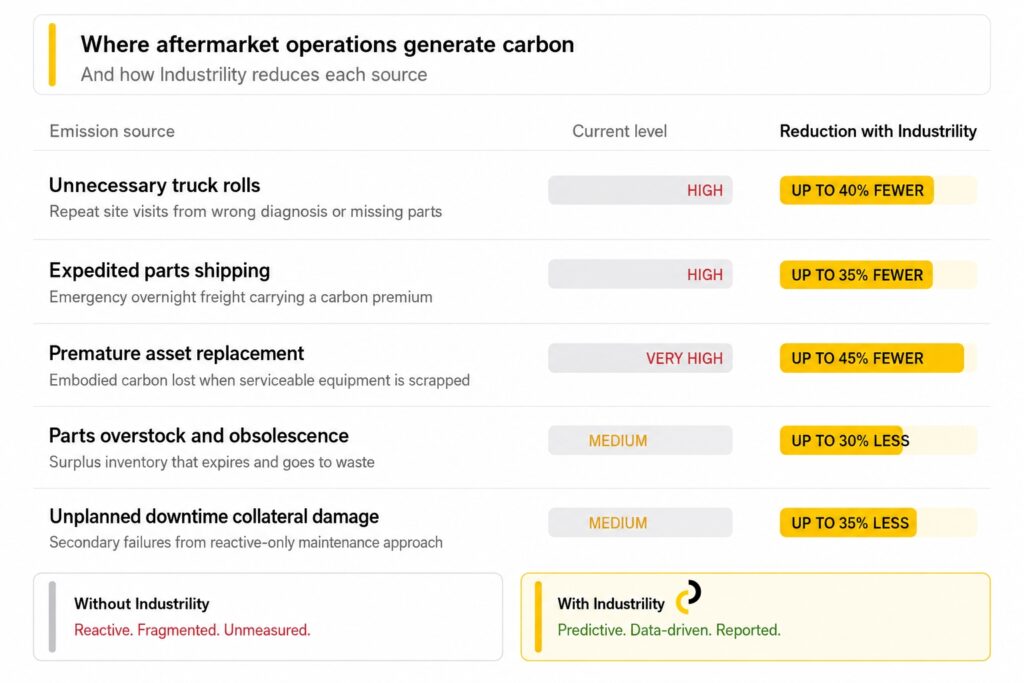
Overstocking is wasteful. Understocking is too, because it triggers expedited shipments with an emissions premium attached. When OEMs know what is installed across their fleet, what has failed historically, and what is likely to fail next, they stock and position parts far more efficiently.
They can also plan more deliberately for remanufacturing and reuse, recovering value from parts that would otherwise be scrapped. This aligns directly with circular economy principles, as outlined in the Ellen MacArthur Foundation’s framework for industrial circularity.
Industrility’s Parts Commerce platform supports this by connecting parts data directly to asset history, enabling smarter procurement and reuse decisions.
4. Remote Resolution and Reduced Site Visits
Not every service event requires a truck. With better asset data, diagnostic tools, and service intelligence, more issues are resolved remotely. When a technician does need to visit, they arrive prepared. Every avoided site visit directly reduces fuel consumption and field emissions. This supports Scope 3 emissions reduction, an area the CDP highlights as one of the most undermanaged sources of corporate carbon output.
5. Asset Life Extension Over Replacement
A complete digital history of each installed asset, including configuration, modifications, service events, and operating context, enables OEMs to prioritize repair, refurbishment, and targeted upgrades over full replacement. Longer asset lifecycles mean lower material consumption and lower embodied carbon per unit of productive use.
Industrility’s Lifecycle app tracks every stage of an asset’s operational life, giving service teams the intelligence to extend it.
Sustainability and Aftermarket Profitability Reinforce Each Other
A critical advantage of the data-driven aftermarket approach is that sustainability and profitability point in the same direction. OEMs do not have to choose between them.
Smarter service offerings increase aftermarket revenue. Reduced waste and inefficiency improve service margins. Higher uptime and transparency strengthen customer retention. And for OEMs selling into markets where ESG performance influences procurement decisions, the ability to demonstrate and report on lifecycle sustainability is becoming a real competitive differentiator. Deloitte’s research on industrial ESG trends confirms that customers and investors are placing growing weight on lifecycle sustainability data when choosing industrial partners.
The aftermarket organization, so often treated as a cost center, has the potential to become a sustainability-driven growth engine. Achieving that requires moving beyond reactive, fragmented operations toward something more intentional.
Closing the Sustainability Reporting Gap in Aftermarket Operations
Even OEMs that recognize the sustainability potential of their aftermarket operations often struggle to measure and report it. Without asset-level lifecycle data, it is nearly impossible to quantify what has been saved. How many assets were extended rather than replaced? How many service trips were avoided? How much expedited shipping was eliminated?
This reporting gap makes it hard to set credible targets, demonstrate progress, or respond to growing disclosure requirements from regulators, investors, and customers. Industrility’s Sustainability ESG Reporting use case addresses this directly. It enables asset-level lifecycle tracking, service and parts impact analytics, and customer-facing sustainability reporting so that progress can be measured, communicated, and built upon.
From Reactive Service to Sustainable Lifecycle Leadership
The sustainability opportunity in aftermarket operations has been hiding in plain sight for a long time. The good news is that the tools to act on it exist today.
The foundation is a reliable, unified system of record for the installed asset base. From there, predictive service, smarter parts management, remote diagnostics, and ESG reporting all become possible. Every step forward reduces environmental impact, improves operational performance, and strengthens customer relationships.
Aftermarket sustainability is not a future ambition. For OEMs that invest in the right data foundation, it is available now.
Schedule a demo with Industrility to see how leading manufacturers are turning their installed base into a sustainability and profitability advantage.