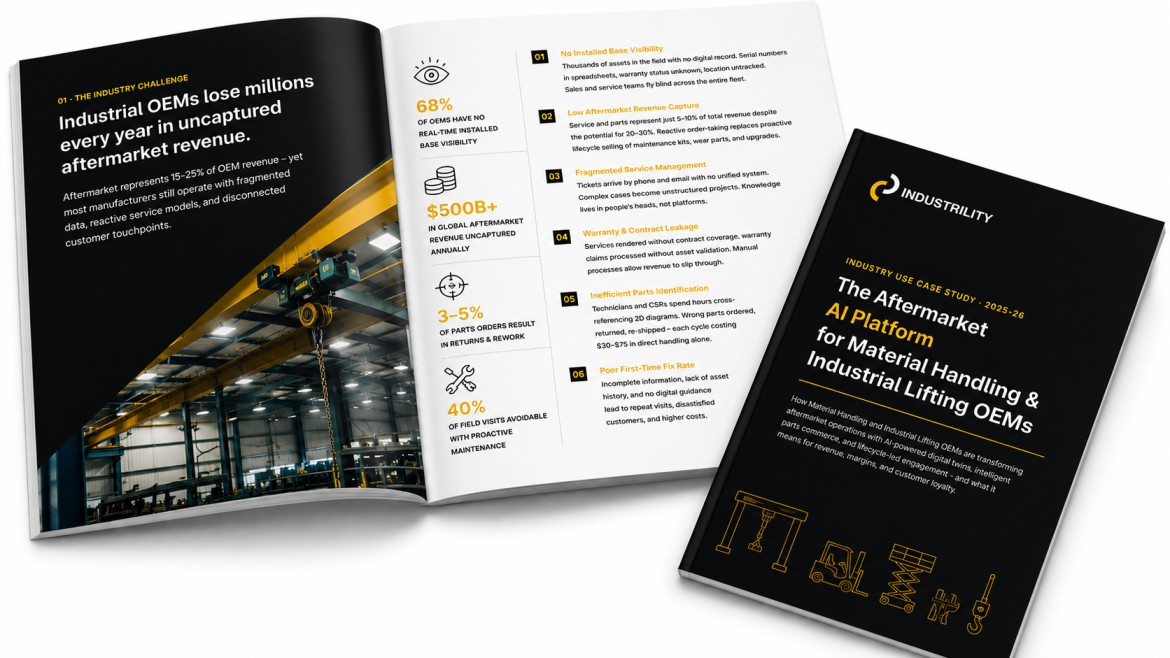
The Aftermarket AI Platform for Material Handling & Industrial Lifting OEMs
Overview
Material handling and industrial lifting OEMs already carry outsized responsibility for revenue, uptime, and customer loyalty. The installed base they have shipped over 15 to 25 years is worth 4 to 5 times the original equipment sale. But most of that value stays invisible. It sits in spreadsheets, dealer inboxes, and technicians’ heads, uncaptured and unmeasured, while less than 20% of the aftermarket’s true potential ever reaches the P&L.
That invisibility is the problem. When aftermarket revenue leaks through fragmented service tickets, warranty gaps, and misidentified parts, it is not a people problem. It is a structural one. And structural problems do not get fixed by working harder inside the same broken tools.
The Aftermarket AI Platform for Material Handling & Industrial Lifting OEMs shows how leading manufacturers are closing that gap. They are replacing reactive, disconnected aftermarket operations with a connected, AI powered layer that turns every asset, every service call, and every parts order into a source of recurring, compounding revenue.
You have already built the installed base. Now it is time to capture what it is worth.
What You Will Learn:
This case study explores how OEMs are shifting from transactional aftermarket to lifecycle led partnerships, and what happens when installed base visibility, digital parts commerce, and AI driven service come together. Inside, you will discover how:
- Aftermarket can grow from under 10% of revenue to a predictable, scalable engine, without adding headcount
- Digital twins and AI powered parts identification eliminate the misidentification, returns, and rework quietly draining margin
- Service agreements and proactive maintenance convert one off transactions into recurring, contract backed revenue
- Real OEMs deploying this model are unlocking $733K to over $1M in annual value on a $100M revenue baseline, with payback in under 90 days
This is your blueprint for turning an underused installed base into a compounding revenue asset, and for making aftermarket performance visible in terms the rest of the business can act on.