Engineering Meets Aftermarket: How Industrility and Siemens PLM Are Closing the Loop in Manufacturing
The Gap Between Design and Aftermarket
When a machine leaves the factory floor, manufacturers face a fundamental question: what happens next?
Engineering teams have invested enormous effort into design, simulation, and production, but once a product ships, that institutional knowledge rarely travels with it. Service teams are left working from outdated PDFs, tribal knowledge, and disconnected systems.
The result is a fragmented aftermarket experience: slow service resolution, incorrect parts orders, and technicians without the guidance they need in the field. Meanwhile, the rich engineering data that could solve these problems sits locked inside PLM systems, inaccessible to the people who need it most – the machine operators and field technicians who rely on it every day.
Industrility and Siemens are changing that.
By connecting Siemens Product Lifecycle Management (PLM) directly to Industrility’s aftermarket solution, manufacturers can now close the loop between engineering and post-sale operations – turning design data into a living service asset that enables true operator self-service across a machine’s entire lifetime.
Industrility and Siemens PLM: A Natural Fit
Siemens is the backbone of product engineering for thousands of manufacturers worldwide. Its Product Lifecycle Management (PLM) platform is where the complete product story lives – from CAD models and Bills of Materials to structured work instructions and service documentation, across every revision, every variant, and every component.
But Siemens PLM is designed for manufacturers. It is a powerful, design-time tool built for internal engineering and service teams. What it does not do is put that knowledge directly in the hands of the operators and customers who run these machines day to day. That is the gap Industrility fills.
Industrility specializes in what comes after shipment: managing assets in the field for the next 20–29 years – the service, parts, and maintenance lifecycle that defines a customer’s long-term experience with a product. Where Siemens PLM is a design-time system for manufacturers, Industrility makes that same intelligence operational and customer-facing.
The integration is a natural extension of the manufacturing value chain. Siemens PLM handles the design and engineering story. Industrility picks it up the moment the product ships and carries it forward – making that engineering knowledge available as a self-service experience for operators, dealers, and field technicians.
For manufacturers already in the Siemens ecosystem, this means activating a world-class operator self-service capability requires no complex data migration, no duplicate data entry, and no costly system integration. The engineering data that already exists in Siemens PLM simply flows into Industrility, ready to power parts catalogs, service workflows, and customer self-service portals from day one.
What the Integration Unlocks
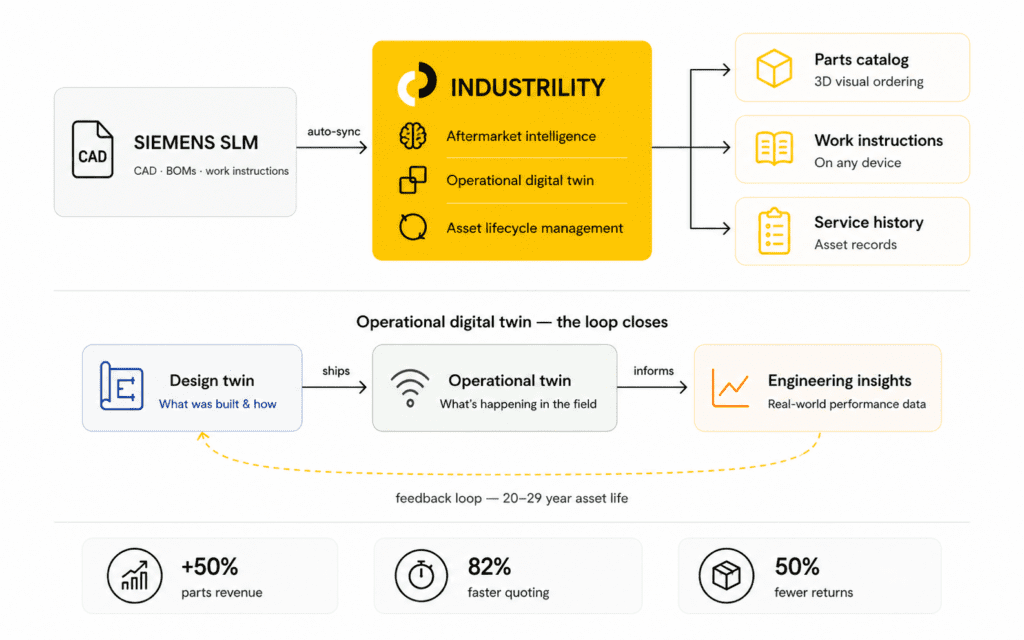
Industrility is now tightly integrated with Siemens PLM, embedding its capabilities directly within the Industrility platform. This gives customers, dealers, and field technicians access to accurate, up-to-date engineering visuals without needing a Siemens license or CAD expertise.
From that foundation, three powerful operator self-service capabilities come to life:
- Interactive Parts Catalog – Technicians and end customers can navigate 3D models and 2D diagrams to visually identify exactly the component they need, without contacting the manufacturer or hunting through static PDFs. Parts are linked directly to live inventory and ordering, eliminating the misidentification errors that drive returns and delays.
- Work Instructions at the Point of Need – Siemens PLM holds structured work instructions on how to operate a machine, how to maintain it, and how to repair specific components. Industrility surfaces these instructions directly within the service workflow as a self-service resource operators can access on any device, wherever they are in the field, without relying on a manufacturer’s support team.
- End-to-End Service Lifecycle Management – With asset history, maintenance records, service cases, and engineering data unified in one place, manufacturers gain full visibility over what is happening with every machine in the field and can act on that data proactively rather than waiting for something to break.
The Operational Digital Twin
Every machine designed in Siemens PLM now has the potential to become a living operational digital twin in Industrility.
Where a design digital twin captures what was built and how, the operational digital twin tracks what is happening in the field: service history, installed parts, open cases, maintenance schedules, and performance data – all anchored to the original engineering model from Siemens PLM, and managed for the next 20–29 years of asset life.
This continuity between design and operations creates a feedback loop that benefits both sides. Engineering teams gain insight into how products perform in real conditions. Service teams gain access to the precise engineering context that makes diagnosis and repair faster and more accurate. And operators gain a transparent, self-service experience that builds confidence in the manufacturer’s long-term support – without having to pick up the phone or wait for an engineer.
Real-World Impact
Manufacturers who have adopted Industrility’s aftermarket platform are already seeing measurable results:
- A compression equipment manufacturer digitized its installed base of over 2,000 machines, launched a branded operator self-service portal, and achieved a 50% increase in service and parts revenue.
- Triveni Turbines improved quoting efficiency by 82%, reduced parts returns by 50%, and standardized service operations across international markets.
With the Siemens PLM integration, these outcomes become faster to achieve and broader in scope – particularly for complex, highly engineered equipment where accurate service data and structured work instructions make the greatest difference.
Aftermarket Intelligence
The richness of Siemens PLM engineering data, combined with Industrility’s deep and automated integration across the service lifecycle, creates a uniquely powerful foundation for AI-driven operator self-service.
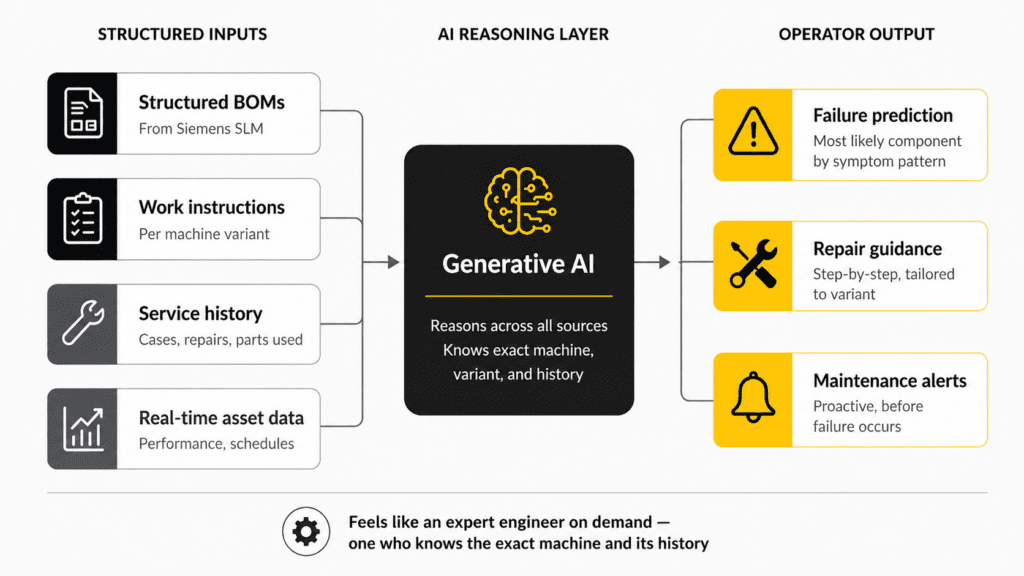
When Generative AI has access to structured BOMs, work instructions, service history, and real-time asset data sourced directly from Siemens PLM, it can do far more than surface information. It can reason about it – enabling manufacturers to offer their operators:
- Recommendations for the most likely failure component based on symptom patterns
- Step-by-step repair guidance tailored to a specific machine variant
- Proactive flagging of preventive maintenance needs before a failure occurs
Combined with immersive 3D visualization, this creates a self-service experience that feels less like a support ticket and more like having an expert engineer available on demand – one who knows the exact machine, its history, and the best path to resolution.
Why It Matters for Manufacturers
The Industrility and Siemens PLM integration delivers compounding advantages across the business:
- Faster Time to Aftermarket Value – For Siemens customers, there is no lengthy integration project. Engineering data from Siemens PLM flows in, and operator self-service capabilities are live, dramatically compressing the time between deployment and revenue impact.
- One Source of Truth Across the Lifecycle – Because aftermarket data traces back to the same engineering record in Siemens PLM, there is no version mismatch between what was built and what service teams and operators are working from. Every stakeholder operates from accurate, current information.
- Scale Without Complexity – Digital workflows, operator self-service portals, and intelligent tooling allow manufacturers to serve more customers across more geographies without a proportional increase in service headcount.
- New Revenue Opportunities – A structured, digital aftermarket foundation makes it straightforward to introduce extended warranties, service contracts, subscription-based support, and premium maintenance tiers – turning aftermarket from a cost function into a meaningful revenue stream.
Enabling Customer Self-Service at Scale
One of the most significant shifts the Industrility and Siemens PLM integration enables is a fundamental change in how manufacturers support their customers – moving from reactive, manufacturer-led service to proactive, customer-driven self-service.
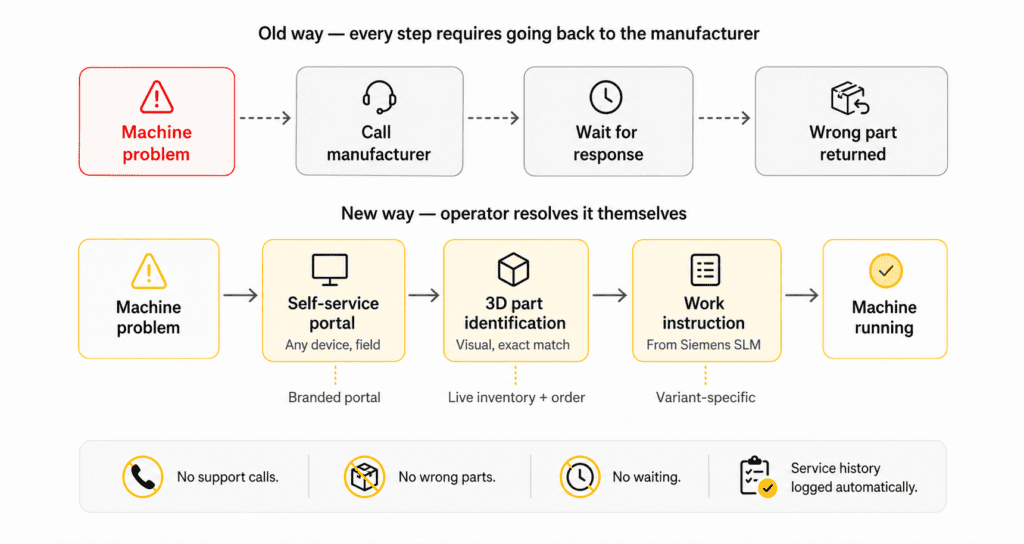
Historically, when an operator needed a part, a work instruction, or service guidance, the process required going back to the manufacturer – back to the original design documents, back to the engineering team, back to a distributor. Every touchpoint added time, cost, and friction. The knowledge existed, but it was locked away in systems operators could not access.
With Industrility‘s tight integration with Siemens PLM, that changes. Manufacturers can now give their customers a branded self-service portal where operators can:
- Identify and order the exact part they need using interactive 3D diagrams – without calling a distributor or waiting for a quote
- Access structured work instructions for their specific machine variant, directly from Siemens PLM, on any device in the field
- View their machine’s full service history, open cases, and upcoming maintenance schedules in one place
- Log operational activities, record completed maintenance, and close out service cases – all tied back to the original engineering record
This is not just a better user experience. It is a strategic shift that reduces service costs, shortens resolution times, and builds deeper customer loyalty. Operators who can solve problems themselves quickly and confidently develop trust in the manufacturer’s product and platform.
For manufacturers, the result is a scalable model: more customers served across more geographies, with less burden on internal service teams. The self-service layer handles the routine; the engineering team focuses on what only they can do.
Closing the Loop
The integration between Industrility and Siemens PLM represents something genuinely new in manufacturing: a direct, seamless connection between the world where products are designed and the world where they are used, serviced, and supported – with operator self-service at the center of that experience.
It closes a gap that has persisted for decades. Manufacturers have long invested in Siemens PLM to manage the engineering story. Now, with Industrility’s tight integration, that same story becomes a living, operational asset – one that operators can access themselves, on demand, wherever they are.
For manufacturers who have already invested in Siemens, the opportunity is immediate. The engineering foundation is already there. Industrility‘s deep integration with Siemens PLM brings the aftermarket layer: the operator self-service portal, the parts commerce, the service workflows, the asset intelligence – and connects it all back to the same engineering record that defined the product from day one.
The loop is closed
The machine’s digital life no longer ends at shipment. It is just getting started.