Curating Data for Winning with AI in Aftermarket
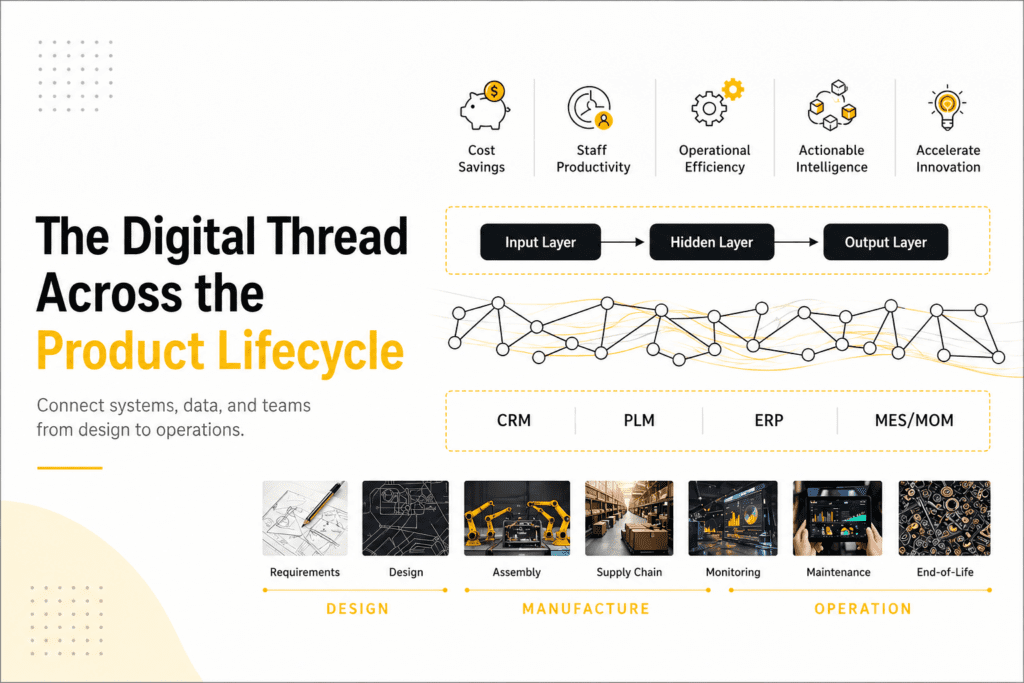
Smart industrial aftersales rely on consistent, rich data about every machine. Without it, even advanced AI systems (digital twins, chatbots, agents) cannot reason effectively. Unfortunately, OEMs often have fragmented data across ERP, PLM, CRM, IIoT and even spreadsheets. Improving data quality and linking records is the first step. A knowledge graph or semantic layer can unify information about parts, manuals, service history and sensor telemetry into a single model — exactly what Industrility’s Installed Base Intelligence platform is built to do.
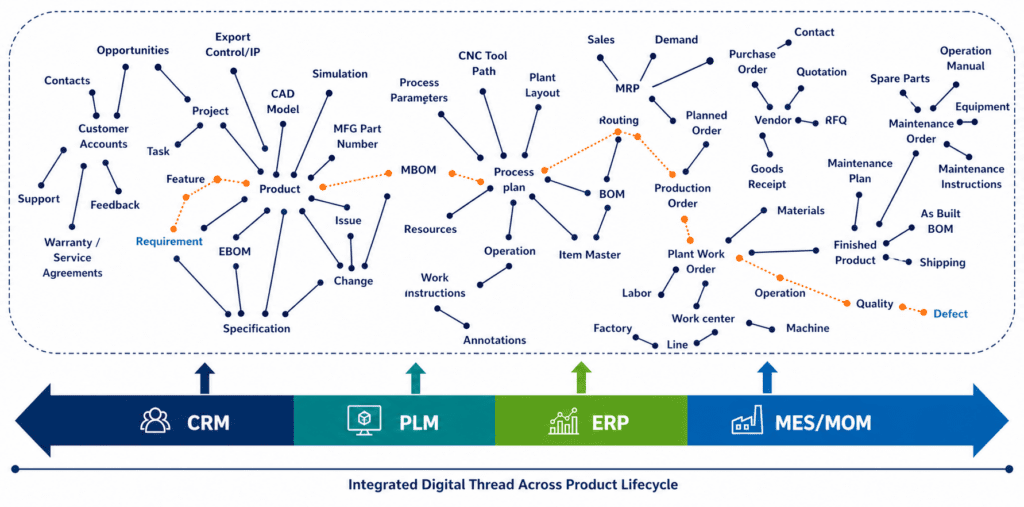
A knowledge graph can unify disparate product data (requirements, BOMs, orders, etc.) across systems, forming a digital thread that aids troubleshooting. By organizing entities (machines, components, work orders, test results) and their relationships, the graph supports semantic queries over the entire lifecycle. For example, engineers can trace a field failure report through change logs and design specs to find root causes. This digital-thread graph lets cross-functional teams quickly extract context-specific views essential for decision-making.
Once data are integrated, you can curate a digital twin of each asset. This means mapping every machine or component serial number to all relevant records (specs, warranty, purchase orders, usage, repairs). Well-structured installed-base data allow service AIs to “know” each asset. For instance, a technician could ask an AI assistant “What was the last maintenance on machine 12345?” and get an immediate answer based on the consolidated history. Similarly, Retrieval-Augmented Generation (RAG) can pull in the exact service manual section or past ticket notes needed for a repair. RAG works by retrieving relevant documents at query time and feeding them to the LLM as context, which makes answers more accurate and grounded in your proprietary knowledge. TwinGPT by Industrility is the industry’s first AI co-pilot for complex machinery that does exactly this.
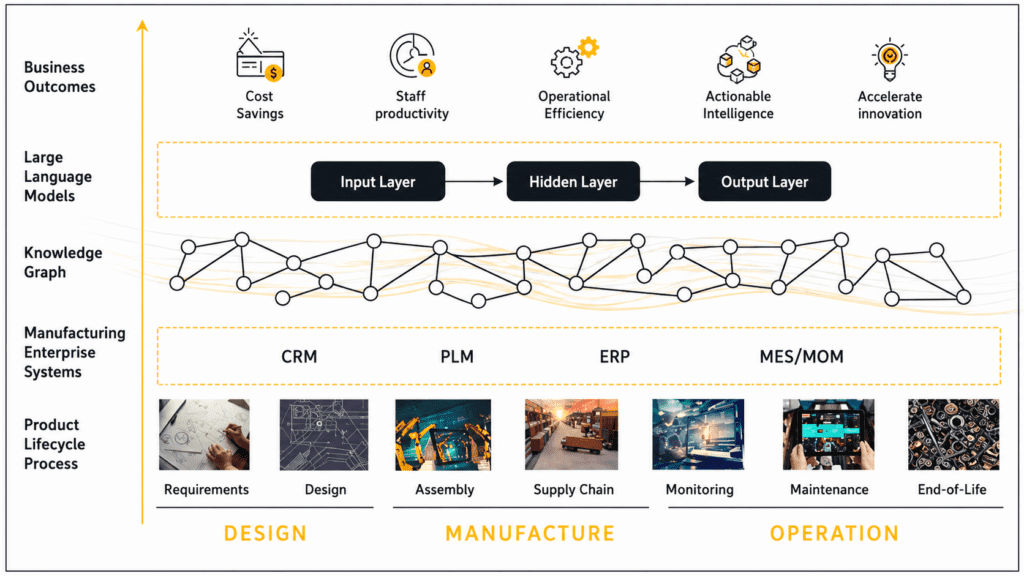
Architecturally, the platform sits as an integration layer across existing systems. Core enterprise software (PLM/CAD, ERP, MES, CRM) manages siloed data, but the knowledge graph federates them with bi-directional APIs. Live IIoT streams (machine telemetry) also feed into the graph to update operating state. On top sits a generative-AI layer: RAG and agent services. In practice, an LLM will only act on curated data from the graph – no more randomly hallucinating from scratch. This ensures AI agents and bots have a single source of truth to draw from when assisting service teams. Learn more about how Industrility integrates with 100+ systems to federate your data.
With this foundation, agentic AI can automate service workflows. We typically think in stages: advise, assist, and automate. An AI adviser (chatbot) lets a technician query any machine’s status in natural language. The next level, a smart assistant, can suggest tasks or parts by analyzing schedules and spare availability (with human approval). Finally, an autonomous agent can take action—like raising a part order when inventory is low or scheduling preventive maintenance—under defined guardrails. In all cases, humans stay in the loop to review exceptions, ensuring safety and trust. Industrility’s Field Service module is designed to support these escalating levels of AI autonomy.
Industrility Use Cases
In anonymized deployments, these technologies solve real problems. A heavy-equipment OEM with ~12,000 machines consolidated decades of siloed asset data into a unified graph. The resulting digital twins enabled an AI co-pilot to instantly recall any machine’s complete history, boosting first-time-fix rates and cutting downtime. A marine-equipment customer implemented parts-intelligence: their graph-driven AI now maps each vessel’s installed parts to the correct OEM catalogs, sharply reducing misidentification errors. A utility-sector client used AI-generated maintenance plans to optimize field schedules, improving reliability. Explore more on the Industrility case studies page.
Key Takeaways for IT/AI Leaders
- Build the Semantic Layer: Adopt knowledge-graph or master-data platforms to integrate ERP/PLM/CRM/IoT. Invest in data governance (standardized IDs, version control) so that the AI layer sees consistent facts. Industrility’s Installed Base Intelligence provides this semantic layer out of the box.
- Leverage RAG for Accuracy: Use vector search or custom retrieval over your manuals, past tickets, and logs. By grounding LLMs in vetted documents, you avoid hallucinations and tap institutional knowledge (even from retiring experts). TwinGPT delivers RAG natively for complex machinery.
- Design Agentic Workflows: Plan for stages of AI autonomy. Start with chat interfaces (advisers), then expand to decision-support assistants, and eventually to more autonomous operators. Define clear handoff points for human approval to ensure safety. Industrility’s Remote Monitoring and Field Service modules support this journey.
- Integrate Extensively: Tackle data silos head-on. Parts and service information in disconnected Excel or PDF systems is a major bottleneck. Aim to integrate the full stack (ERP, PLM, MES, PDM, spreadsheets) so your knowledge graph has maximum coverage. See Industrility’s full integrations directory.
- Monitor Data Health: Regularly audit and clean data. Inaccurate part numbers or missing certificates will cause AI errors. Use AI-driven data-cleansing tools to maintain trust in the system.
With high-quality data and a federated AI architecture, industrial OEMs get a “digital co-pilot” for each machine. The result: 24×7 support, faster troubleshooting, and greatly improved uptime – precisely the benefits that digital twins, RAG chatbots, and agentic AI promise.
Data-Driven Aftermarket for Business Leaders
Industrial manufacturers are undergoing a strategic shift: moving from one-off equipment sales to continuous outcome-based services. High-quality data and operational digital twins are at the heart of this transformation. By digitally capturing each machine’s lifecycle (from design through field performance), companies unlock new service models and revenue streams. According to BCG, leading OEMs now generate around one-third of their revenue from aftermarket services, and service revenue is growing faster than equipment sales. In other words, service is no longer an afterthought – it’s a core business. Industrility’s platform is purpose-built to help manufacturers capture this opportunity — learn more about servitization and monetization consulting.
Customers are driving this change. Many buyers now prefer access over ownership for heavy machinery. Subscription customers also tend to spend more: shifting buyers into subscription models can make them up to 2× more profitable than one-time purchasers. In practice, subscription-based OEMs see revenue grow roughly five times faster than their equipment-only peers. This means that CEOs who embrace outcome-oriented contracts can create a steady, growing revenue stream instead of one-off sales.
However, capturing these gains requires overcoming major hurdles, especially around data. Fragmented product and service data makes it impossible to deliver seamless support. Disconnected Excel sheets and legacy PLMs leave gaps that frustrate customers with long lead times and wrong parts. At the same time, knowledge on how to service older machines is leaving the company: about 31% of U.S. service engineers are over 55 years old. Each retiring veteran takes untold machine know-how with them. Without a digital transformation, these trends eat away at margins and customer satisfaction.
This is where operational digital twins and AI-driven tools deliver business value:
- Hyper-Personalized Service: By combining digital twins with AI co-pilots, each customer experience becomes tailored. A support chatbot that knows a machine’s exact configuration can recommend the right parts, maintenance schedules and consumables for that individual customer’s usage. Industrility’s Parts Commerce delivers an AI-enabled, hyper-personalized 3D parts catalogue that drives wallet-share and upsell.
- Risk Transfer: In outcome-based deals, the OEM often assumes the risk of downtime. Digital twins mitigate this risk through visibility. By continuously monitoring each asset’s digital twin (sensor health, usage patterns, service history), companies can service equipment before failures happen. Explore Industrility’s Uptime Program use case to see how this works in practice.
- Competitive Differentiation: As machinery becomes commoditized, data and service are the new moat. High-quality service data lets an OEM differentiate itself as a partner, not just a parts supplier. In essence, the OEM sells reliability and outcomes. Industrility’s Customer Support platform and MyOEM portal create the branded, always-on customer experience that cements this differentiation.
The upside is clear: high-performing manufacturers (those that master aftermarket services) consistently beat competitors in loyalty and profits. These companies see larger profit margins (typically 30–50% on services vs ~20% on products) and deeper customer relationships.Transparency and Uptime Guarantees: A digital twin (a unified data record for each asset) makes performance predictable. AI-driven predictive maintenance typically cuts maintenance costs by 10–40% and reduces unplanned downtime by ~35–50%. With this insight, an OEM can confidently offer uptime guarantees or premium maintenance contracts. Industrility’s Remote Monitoring module turns live IIoT sensor data into predictive alerts that make uptime guarantees deliverable.
Executive Takeaways
To succeed, focus on data quality and digital twins now. Invest in integrating all your product, parts, and field data into a coherent platform. Use AI to convert that data into customer insights: personalized maintenance schedules, smart spare-part catalogs, and AI co-pilots for technicians. Shift your offerings from selling machines to selling uptime and performance – the economics favor recurring, high-margin service income. Address key pain points (siloed Excel data, aging workforce, part-identification errors) with digital solutions. As the marketplace shifts, the companies that act early will lock in customers and fend off commoditization.
In the words of Industrility’s founders: make every machine “tell its story” through its lifecycle. This narrative – captured by operational digital twins and empowered by AI – will become the foundation for long-term growth, customer loyalty and competitive advantage in the industrial aftermarket.